






CISOs support AI adoption. Getting involved before the decisions are made is a different problem.
CISOs support AI adoption. Getting involved before the decisions are made is a different problem.
This is Blog 5 in our Data Trust + AI Success Series
- Why seeing AI risk isn't enough to protect you from it
- Security by obscurity just died. AI killed it.
- Why AI doesn't behave like a human
- Why most AI projects are failing
- Why CISOs need a seat at the AI design table
- Why AI is a stress test of your security fundamentals
- How high data trust speeds up AI
- What are the minimum viable security controls for AI?
There's a framing problem that keeps showing up in boardrooms. The business deploys AI. The CISO finds out afterward. An incident surfaces. Everyone agrees that security should have been involved earlier. And then the same pattern repeats with the next initiative.
In MIND's research, The Impact of Data Trust on AI Success, the CISOs we interviewed weren't describing a conflict. They were describing a communication problem with real organizational consequences. They want AI to succeed. What they can't always do is get the business to understand the risk landscape it's walking into before the architecture is already set.
What matters: CISOs want AI to succeed. The challenge is getting the business to make risk decisions explicitly, before the architecture is already set.
Why is AI adoption outpacing security involvement?
Business leaders are setting the pace. CEOs, COOs and business unit owners are driving AI adoption, and the urgency is real. AI offers competitive advantage and the organizations moving fastest are the ones capturing it.
That speed creates a structural problem for security. When a tool is vetted, purchased and deployed before security gets visibility, the best the CISO can do is assess exposure after the fact. Governance frameworks that were designed to be proactive end up operating reactively by default.
Our research found the same pattern at scale. Ninety percent of organizations are already running enterprise-grade GenAI. The majority of those deployments happened with security playing catch-up, not catch-before.
Why is translating AI risk so difficult?
Most risk conversations in the enterprise have a shared vocabulary. Regulatory exposure maps to compliance budgets. Breach costs map to cyber insurance. These framings aren't perfect, but they're legible to finance and legal and boards.
AI risk doesn't reduce neatly. It lives in system behaviors, data flows and emergent outputs that most executives aren't positioned to evaluate directly. When an AI agent inherits broad permissions and starts surfacing data at machine speed, the exposure doesn't look like a line item. It looks like a tool that's working exactly as designed.
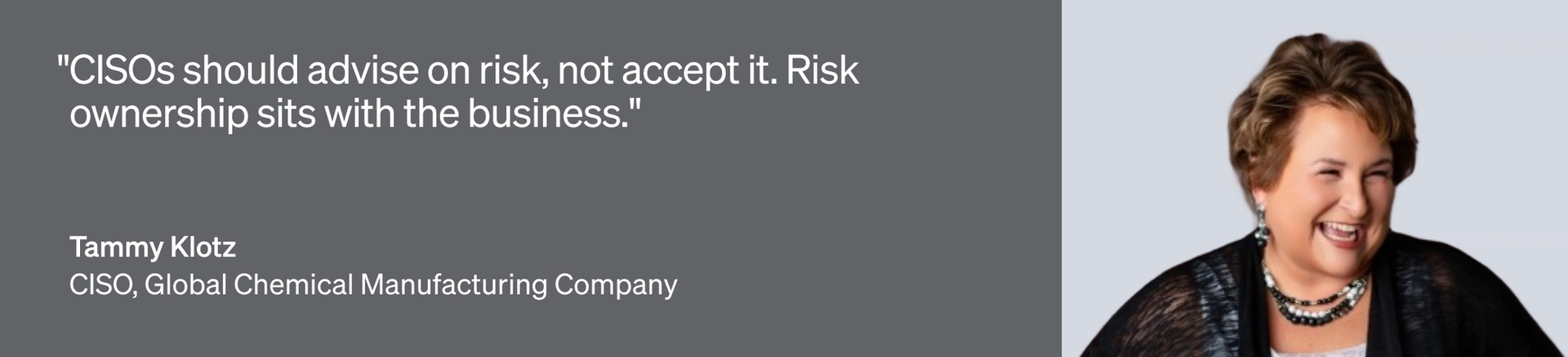
The problem is that risk ownership requires risk literacy. And for AI specifically, that literacy is still being built at the executive level. When the translation succeeds, security earns a seat at the design table. When it doesn't, the business proceeds and governance gaps widen by default.
What happens when the CISO isn't at the design table?
One organization in our research deployed a commercially available AI productivity tool after a standard vendor review. Within weeks, security started receiving alerts that looked like insider threat activity: a single account exfiltrating files at high volume across multiple drives. Investigation found the tool was using employee credentials to download and process files autonomously. No malicious actor. No policy violation. Just an AI tool doing exactly what it was built to do, on a data estate that was never scoped for that behavior.
That's the real cost of late involvement. Governance gaps widen by default, quietly, while the business continues to accelerate. A failed project is visible. A governance gap that compounds over six months rarely gets named until something goes wrong.
When security isn't at the design table, the decisions still get made. They just get made without the visibility that changes them.
How do CISOs make the risk translation land?
The CISOs in our research who describe the strongest relationships with business leadership share a recognizable approach. They don't lead with what AI can't do. They anchor the risk conversation to business consequences the executive team already understands: what a failed initiative costs, what regulatory exposure looks like in their specific industry, what competitive disadvantage compounds to over 18 months.
They also reframe the function itself. The CISOs who earn early involvement consistently describe security as the team that defines the conditions under which yes is possible, not the team that says no. That distinction matters. Organizations where security is perceived as a blocker are the ones where business units route around it entirely.
What does early security involvement actually change?
Getting security into AI program design before the architecture is set changes three things.
- It changes the data access model
When security is involved from the start, agents get scoped access to the data they need for their task. They don't inherit the broadest available permissions simply because that was the default. - It changes the outcome framework
CISOs who earn early involvement are the ones who help define what success looks like before a single query is run. That measurement discipline is what makes failure visible while there's still time to fix it. - It changes the risk posture
Governed AI programs move faster than ungoverned ones because the teams running them know what they're working with. Speed and safety compound together rather than trade off.
MIND isn't just inventorying what data AI tools can reach. It's minding the governance gaps that widen quietly when the business moves faster than the framework beneath it, so security teams have the visibility to earn and keep that seat at the table.
Where do CISOs go from here?
This is the fifth insight in a connected arc. The full report walks through all seven, including what high-performing security teams are doing to close the gap between AI adoption and data trust.
Read The Impact of Data Trust on AI Success to see what the organizations getting this right are doing differently, and where the ones still catching up are losing ground.