








High data trust is becoming the quiet difference between AI programs that scale and ones that stall.
High data trust is becoming the quiet difference between AI programs that scale and ones that stall.
This is Blog 7 in our Data Trust + AI Success Series
- Why seeing AI risk isn't enough to protect you from it
- Security by obscurity just died. AI killed it.
- Why AI doesn't behave like a human
- Why most AI projects are failing
- Why CISOs need a seat at the AI design table
- Why AI is a stress test of your security fundamentals
- How high data trust speeds up AI
- What are the minimum viable security controls for AI?
There's a finding in MIND's research that's easy to lose under all the risk numbers. The security leaders who described the most confident path forward with AI weren't the most cautious ones. They were the fastest. In a study of 124 security leaders run with CISO Executive Network, alongside 20 in-depth CISO interviews, one profile kept repeating. Teams that had classified their data and governed who could reach it were scaling AI while their peers were still arguing about whether it was safe to begin. The Impact of Data Trust on AI Success gives that profile a name. It calls high data trust a competitive accelerant, and the advantage it creates is already widening.
What matters: When your data is classified and access is governed, moving fast with AI stops being a gamble. That foundation is the real source of the speed advantage.
Why are some organizations moving faster with AI than others?
The honest answer isn't appetite for risk. Ninety percent of the organizations in the research are already running enterprise GenAI, so almost everyone has started. The difference shows up in what happens next. Only about one in five of those AI initiatives are meeting the KPIs they were meant to hit, and nearly two thirds of security leaders say they aren't confident in their AI data security controls.
The teams pulling ahead removed the friction before it could stall them. When data is classified and access is governed, an AI use case starts from a known position instead of a guess. Outcomes get defined up front. Agents work inside boundaries someone actually set. Security shows up as a design partner rather than a gate at the end. That's what lets a program move from idea to production without a six-week detour to work out what the model can see.

What does high data trust actually look like inside an organization?
It's less abstract than it sounds. The CISOs who described operational confidence, not aspiration, shared a recognizable setup. They had visibility into their data estate, so they knew what existed and what shape it was in. Their identity framework had been extended to cover non-human actors, which meant an AI agent carried a trackable identity instead of borrowed human permissions. Enforcement ran at the same speed as the AI touching the data, or there was a clear plan to get it there.
From that position, AI stops being a risk to manage and becomes a capability to direct. The report is blunt about the distinction. Governance without enforcement is intention without effect. Data trust is what closes that gap, and it behaves like an operating condition rather than a policy document.
Why is the gap between AI leaders and laggards widening?
Because data trust compounds. Every well-scoped AI project an organization ships makes the next one easier, since the classification and identity work is already done. Clean data invites broader experimentation. Governed identities let new agents deploy with defined scope instead of inherited risk.
For organizations still carrying data debt, the same dynamic runs in reverse. Every new initiative launched on an unclassified estate adds exposure. Every agent deployed without proper identity governance inherits permissions it was never meant to have, at machine scale. The research found the divide is already measurable in the confidence numbers, and AI is being adopted faster than most teams can close that gap by reacting to it. The foundation that removes the risk turns out to be the same one that creates the speed.

How does data trust turn security into a speed advantage?
This is where the security team's role changes. Once you can see your data and govern who and what reaches it, enforcement becomes the thing that lets the business say yes quickly instead of the thing that says no slowly.
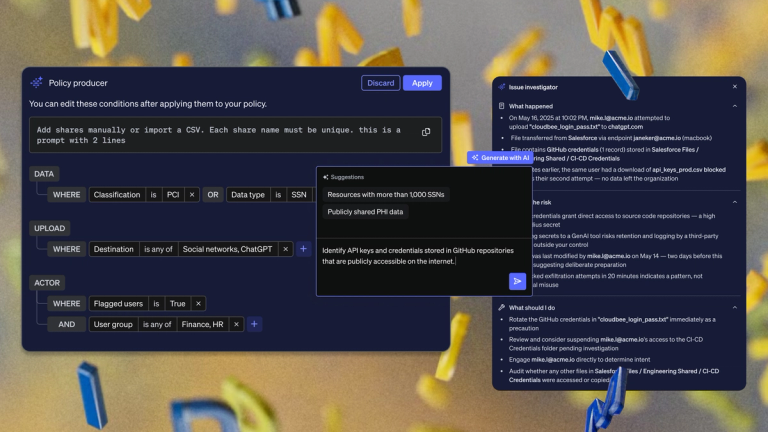
That's the work MIND focuses on. MIND discovers and classifies sensitive data across your environment, then watches how it moves to GenAI tools and AI agents in real time. We aren't just inventorying what AI can reach. We're minding the boundary between the data your AI should use and the data it should never touch, so your team can approve new initiatives with the visibility to back the decision.
With that foundation in place, the security team becomes the group that makes fast AI adoption defensible, instead of the group asked to clean up after it.
Where should you start building data trust?
Start with visibility. You can't enforce policy on data you haven't classified or govern an agent reaching an estate you haven't mapped. Everything else in the research, from identity governance for non-human actors to outcome measurement, depends on knowing what data you have and where it lives.
The full report, The Impact of Data Trust on AI Success, walks through all seven insights, including what the organizations getting this right are doing differently. If your team is being asked to move faster with AI, it's worth seeing where data trust is already separating the leaders from everyone catching up.
Let's mind what matters.