







Breaches don't land where your tools are watching. They land in the spaces between them.
Breaches don't land where your tools are watching. They land in the spaces between them.
IBM's 2026 Cost of a Data Breach Report landed this week. The headline number is $4.99 million, the new global average cost of a breach, up 12% from a year ago. Read past the headline and a quieter pattern emerges. The breaches in the study didn't defeat security tools head-on. They went around them, through AI workloads nobody had inventoried, unsanctioned chatbots nobody was monitoring and data that sat encrypted in one state but not the other. IBM and Ponemon Institute studied 602 breached organizations across 16 countries. What they documented, finding after finding, is the price of coverage that stops halfway.
What did IBM's 2026 Cost of a Data Breach Report find?
Ponemon Institute conducted the research. IBM sponsored it and analyzed the results, covering breaches experienced between March 2025 and February 2026. Four findings stand out for anyone responsible for data:
- One in four malicious breaches were AI-enabled, a 56% increase over last year, according to IBM. Those breaches cost an average of $6 million, roughly $1 million above the global average.
- More than 20% of organizations reported a breach targeting AI models or applications. The most common entry points weren't the models themselves. They were compromised APIs, applications or plug-ins (27%) and cloud misconfigurations affecting AI workloads (27%).
- The share of security incidents involving shadow AI more than doubled year over year to 43%, as Cybersecurity Dive highlighted in its coverage of the report. More than two thirds of organizations had no governance process to limit it.
- Only 37% of breached organizations encrypt sensitive data both at rest and in transit.
There's one more number worth sitting with. Among organizations that suffered attacks on their AI models, 92% had failed to properly control access to those tools. Identity controls, IBM's researchers wrote, have failed to keep pace with AI's sprawl across corporate networks.
Why do breaches keep landing between security tools?
None of these findings describes a security tool failing at its job. Each one describes a place where no tool was doing a job at all.
That's the uncomfortable read of the 2026 data. DSPM watches data at rest. DLP watches data moving through sanctioned channels. Neither was designed to own the AI workload spun up last quarter or the identity of an agent acting on a human's behalf. The encryption finding makes the pattern concrete. When only 37% of organizations protect data both at rest and in transit, it's rarely because encryption is hard. It's because each state of the data belongs to a different tool, owned by a different team, with a gap where the handoff should be.
Shadow AI is the same story at higher speed. An employee pastes a customer record into an unsanctioned chatbot. The endpoint tool wasn't watching that channel. The data-at-rest tool never saw the data leave. Every product performed to spec. The record is gone anyway.
The instinct now will be to spend. In follow-on research by Ponemon Institute, 85% of organizations said they plan to increase security spending after becoming aware of advanced frontier AI capabilities. That money matters. But if it buys another point tool for another slice of the problem, it deepens the very pattern the report documents. More tools mean more seams. Breaches live in seams.
What does complete data security actually look like?
It doesn't have to be this way. Nothing in the IBM data is a law of nature. The gaps are an architecture choice. Architecture can be chosen differently.
Complete means one platform that sees data at rest and data in motion from the same place. It means coverage across SaaS apps, on-premise file shares, endpoints, email and AI tools, because that's where data actually lives now. It means identity and data understood together, so the controls know who or what is touching a file, including when the who is an AI agent with human-level permissions. And it means working with what you already run. Existing data labels and Purview deployments should get smarter rather than get replaced.
Measured against that standard, most of what the market sells is a partial answer. The 2026 report is what partial answers cost.
How does MIND close the gaps in one platform?
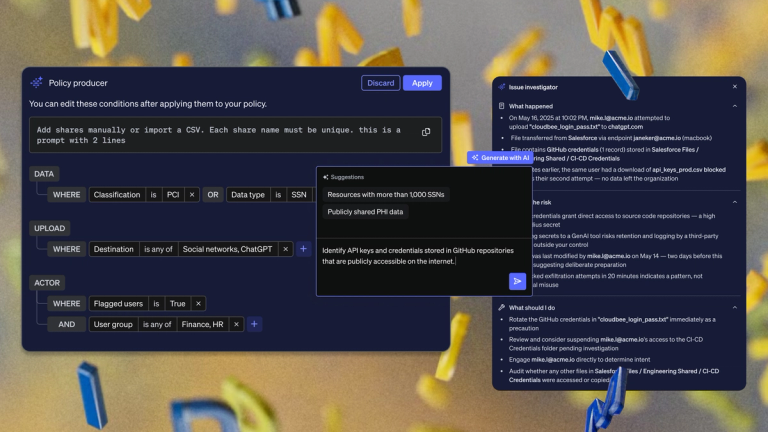
MIND was built on the premise that the seams are the problem. Discovery, detection and prevention run in a single platform. Coverage spans every environment and both states of your data. Multi-layer classification reads content and context together, so the system understands what a file is and what it's doing rather than pattern-matching in one channel. Real-time prevention works at the endpoint and in the browser, which is where shadow AI actually happens. There's no SSL inspection and no latency tax. Because MIND's controls extend to agentic AI identities, the agent your CFO announced last month operates inside the same boundaries as a person.
MIND is minding the spaces between your tools, the seams where IBM's 602 breached organizations came apart, so your team can stop patrolling handoffs and start setting strategy.
Al Faiella, Senior Director of Security Engineering at ThoughtSpot, put it plainly.
“MIND allows us to see and protect our data across every vector, endpoints and SaaS, from a single place. It's like having a spotlight that shines where visibility didn't exist before.”
Al Faiella
Senior Director of Security Engineering, ThoughtSpot
Where should a security leader start?
The IBM report will anchor plenty of budget conversations this quarter. Before the next tool gets added to the stack, it's worth asking a simpler question. Where does your current coverage stop? If the honest answer includes AI tools, agent identities or one state of your data, see what complete coverage looks like in your own environment. Deployment takes minutes and insights arrive within days. That's Stress Free DLP.
Let's mind what matters.
FAQ
- What is the average cost of a data breach in 2026?
$4.99 million globally, according to IBM's 2026 Cost of a Data Breach Report, up 12% from the year before. AI-enabled malicious breaches averaged $6 million. - What is shadow AI?
Shadow AI is the use of AI tools employees adopt without security approval or oversight. IBM found the share of security incidents involving shadow AI more than doubled year over year to 43%. - Why do breaches keep happening despite security tools?
Most stacks are built from point tools that each watch one channel or one state of data. Breaches land in the gaps between them, where no tool is doing a job at all. - What is the difference between DSPM and DLP?
DSPM maps and manages risk in data at rest. DLP protects data in motion through monitored channels. Neither was designed to cover AI workloads or agent identities on its own. - What does complete data security mean?
One platform that covers data at rest and in motion across SaaS apps, on-premise file shares, endpoints, email and AI tools, with identity and data understood together. - Does MIND replace Microsoft Purview?
No. MIND complements existing Purview deployments and data labels, so what you already run gets smarter. - How does MIND stop shadow AI data leaks?
MIND prevents sensitive data from moving into unsanctioned AI tools in real time, at the endpoint and in the browser, without SSL inspection. - How quickly can MIND be deployed?
Deployment completes in minutes and insights arrive within 24 hours.