






AI doesn't create new risk. It surfaces what you already carry, at machine speed.
AI doesn't create new risk. It surfaces what you already carry, at machine speed.
This is Blog 6 in our Data Trust + AI Success Series
- Why seeing AI risk isn’t enough to protect you from it
- Security by obscurity just died. AI killed it.
- Why AI doesn’t behave like a human
- Why most AI projects are failing
- Why CISOs need a seat at the AI design table
- Why AI is a stress test of your security fundamentals
- How high data trust speeds up AI
- What are the minimum viable security controls for AI?
AI doesn’t break your security. It finds where your security was already broken. Every CISO we spoke with in MIND’s research with CISO Executive Network described some version of the same moment. An AI tool got pointed at a data estate, and within days it surfaced something that had been sitting there exposed for years. Nobody planted a new flaw. The flaw was already there. AI just reached it faster than anyone could react.
That reframes the whole conversation. The question isn’t whether AI introduces danger. It’s whether your foundation can absorb the speed at which AI exposes the danger you already have.
What matters: AI doesn’t introduce new vulnerabilities. It accelerates through the ones already there, faster than governance was ever built to respond.
Does AI actually introduce new security risks?
Mostly, no. AI accelerates through the gaps that already exist. The organizations that neglected data classification and identity governance are now meeting those deficits at machine speed instead of human speed.
Think about what changed. For years, weak fundamentals were survivable because no system went looking for everything at once. Unclassified files stayed quiet. Overshared folders stayed unnoticed. Then an AI tool connected to the same environment and read all of it without pausing to ask whether it should. The vulnerability didn’t appear. It got amplified.
This is why we describe AI as a stress test rather than a threat. A threat is external. A stress test measures whether what you already built can hold under load. AI is the load.
Why does AI expose weak fundamentals at machine speed?
Because every deficit compounds the moment velocity enters the picture. An organization that can’t enforce policy also can’t govern what AI does to its unclassified data. When the thing accessing that data moves at machine speed and applies no human judgment, both gaps widen at once and they keep widening.
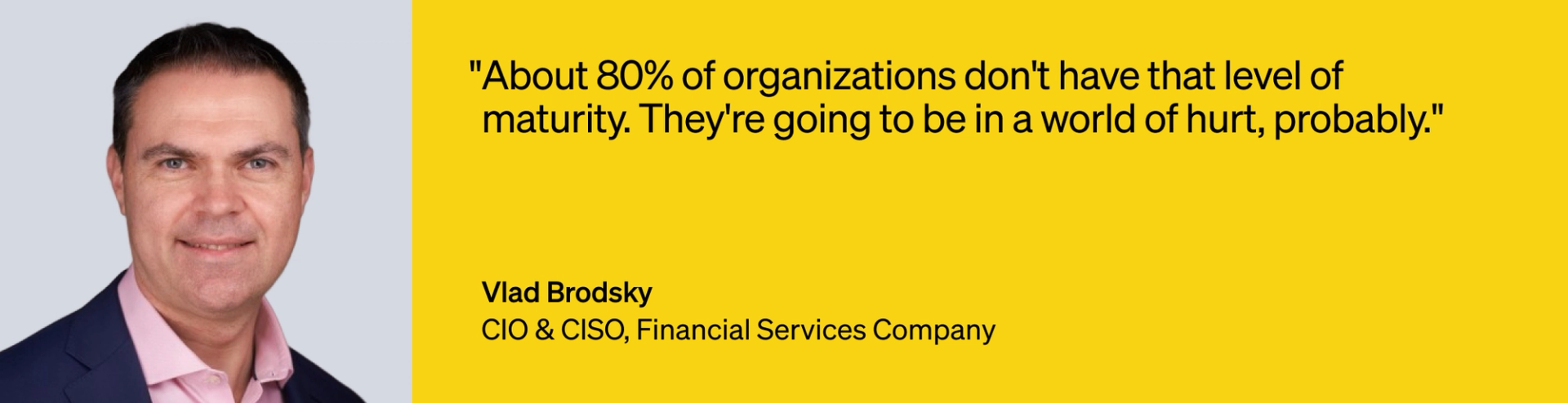
We mapped this across the earlier findings in this research. The enforcement gap, the shaky data estate, the agent that doesn’t behave like a human. Each one was manageable on its own when work moved at human pace. Under AI velocity they stack. The result is exposure that surfaces faster than governance was ever designed to respond.
Are only 20% of organizations ready to run AI safely?
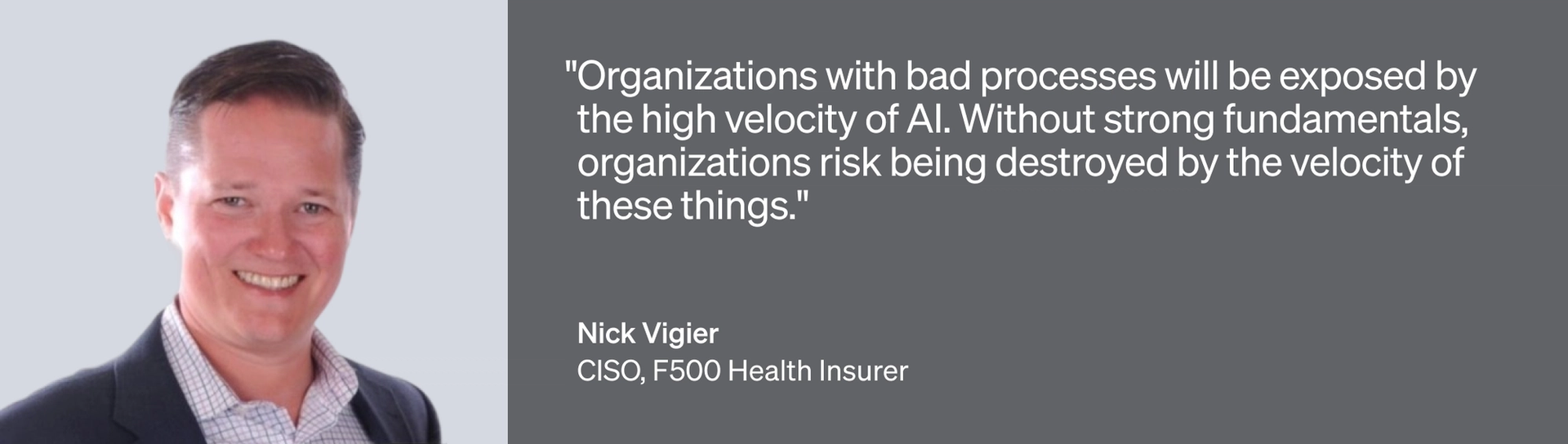
According to the CISOs in this study, few have the security maturity to run AI safely at scale. In fact almost 80% are lacking and the consequences run from stalled projects and regulatory exposure to, for smaller organizations, events serious enough to threaten the business itself.
That number lands hard when you set it against adoption. Ninety percent of the organizations surveyed are already running Enterprise GenAI, and 65% of their security leaders aren’t confident their controls can prevent unsafe AI data access. So the maturity gap and the deployment curve are pointed in opposite directions. Tools are live. Confidence is not.
None of this is hypothetical. The conditions are already in place.
What happens when AI inherits access no one scoped?
It does exactly what it was told to do, and that’s the problem. At one research organization, a staff member used an enterprise AI tool to build a participant cohort. The tool ran under that person’s credentials and reached data sources that should never have been part of the query. The output contained records the researcher had no authorization to see.
No policy was technically violated. The tool performed the function it was built for. The access framework had simply never been extended to govern what an AI system could reach. That’s the quiet danger of agents inheriting broad human permissions without human judgment. They operate at the full scope of what they can touch, not the narrow scope of what they actually need.
This is the foundational debt of identity governance, surfacing as an AI incident. The permission was always too broad. AI just used all of it.
How do you pass the audit AI is already running?
You start by treating data trust as the foundation, not the afterthought. The CISOs describing the most confident path forward shared a clear profile. They had visibility into their data estate. They had extended identity governance to cover non-human actors. They had enforcement that runs at AI speed.
That’s where MIND fits as a guide. We aren’t just scanning files for patterns. We’re minding the integrity of your data estate so an AI tool can’t quietly reach what it was never meant to see. MIND discovers and classifies sensitive data wherever it lives, then enforces policy on data in motion as it flows toward GenAI and agents, at the speed those systems actually move.
The point was never to slow AI down. A strong foundation is what makes fast safe. When the fundamentals hold, AI stops being the audit you’re afraid of and becomes the accelerant you can direct.
Where do we go from here?
If you’re rolling out AI faster than you can govern it, that’s the gap to close first. See what MIND surfaces in your own environment, and find out what the audit would reveal before it reveals itself. That’s DLP at AI Speed, and it’s how you mind what matters most.
Read The Impact of Data Trust on AI Success to see all seven insights, the CISO interviews behind them and what the organizations getting it right are doing differently.
Data Trust + AI Success Blog Series
- Why seeing AI risk isn’t enough to protect you from it
- Security by obscurity just died. AI killed it.
- Why AI doesn’t behave like a human
- Why most AI projects are failing
- Why CISOs need a seat at the AI design table
- Why AI is a stress test of your security fundamentals