









Introducing MIND’s DLP Savings Estimator!
Introducing MIND’s DLP Savings Estimator!
Data loss prevention (DLP) has never been a question of if it’s needed. For most security leaders, the real question is what it’s actually costing them to manage and operate.
- Not in license fees.
- Not in shelfware.
- But in valuable time, critical headcount and constant tradeoffs.
Security teams know the feeling well. Alerts pile up faster than they can be triaged. False positives drown out real risk. Coverage gaps quietly become accepted as “good enough.” And the unspoken reality sets in: most teams are only able to investigate a fraction of the alerts they generate. In fact, most teams only triage about 65% of alerts within 24 hours.
This is where confidence erodes. Not because teams don’t care, but because the math doesn’t math. There are just not enough analyst FTE hours in a year to get to them all.
That’s why we built the MIND DLP Savings Estimator. Not as a marketing gimmick, but as a way to make the invisible visible. To help security leaders understand what it really takes to mind what matters and what changes when DLP works differently.
What assumptions did we use to build this estimator?
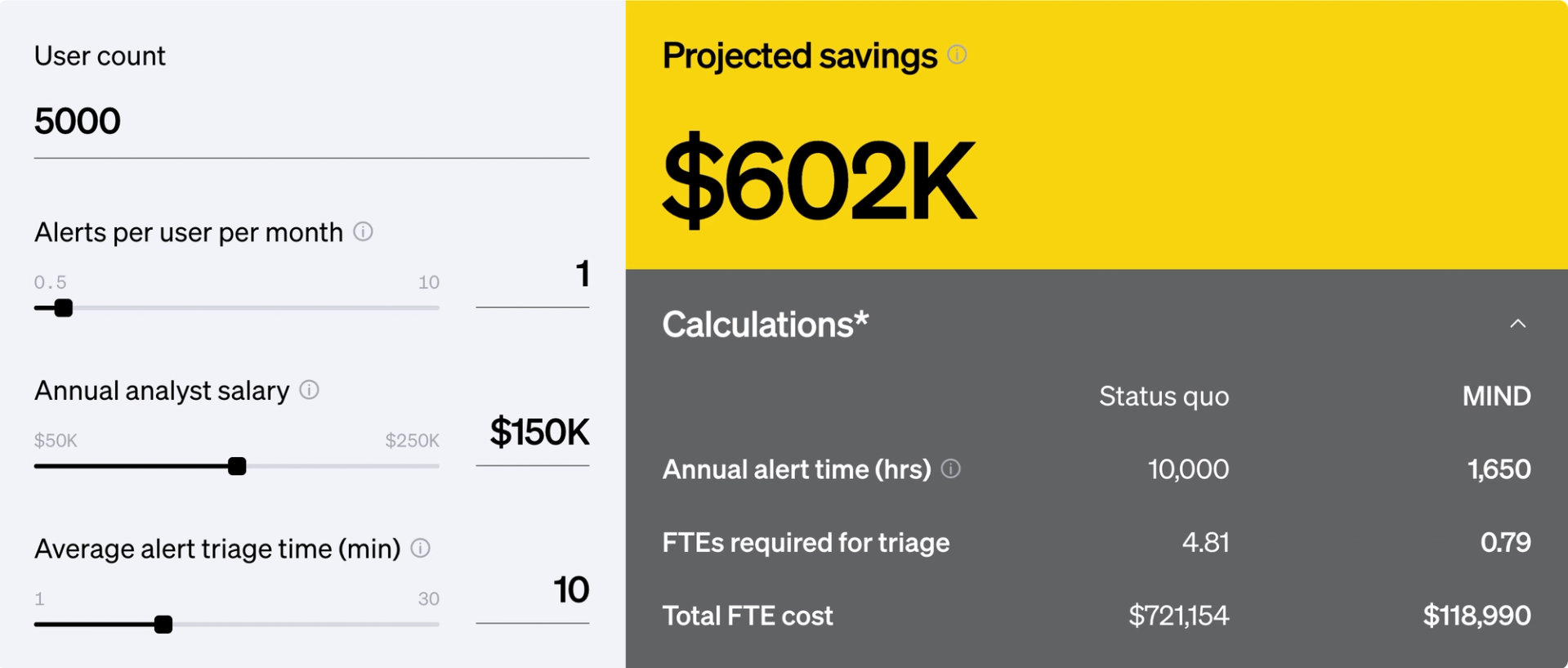
We’ve all seen ROI calculators that feel disconnected from reality. That’s not the goal here. Every input in the estimator is visible and adjustable, because every environment is different. You can tune:
- The average number of data security alerts generated per user each month
- Analyst compensation assumptions
- The average time required to triage a single alert
Each default value is grounded in direct CISO feedback, but none are locked. The point isn’t to tell you what your environment looks like. It’s to let you reflect it accurately. This transparency matters. Because operational savings only mean something if they’re credible.
This estimator also projects the amount of resources needed to build out your team to handle 100% of DLP alerts. Since most teams are not
What changes with MIND?
Once the baseline is established, the estimator shows what happens when DLP stops behaving like a volume problem and starts behaving like a prioritization problem.
MIND reduces total alert volume by an average of 67% (SOURCE: MIND customer installations and CISO interviews) through smarter data classification, automated remediation and user-guided enforcement. Fewer alerts and false positives mean fewer investigations. Better context means faster decisions. Automation means less manual effort across the board.
“We’re spending probably a fifth of the time we used to managing our DLP program.”
Yaron Blachman
Chief Information Security Officer, OpenWeb
Instead of asking, “How many analysts do we need to keep up?” the model shifts the question to, “What could we do if we didn’t have to?”
“MIND was a lot more accurate and I can't remember a single case where we had false positives.”
Mike Moratto
CISO & Head of IT, Noname Security
The savings shown aren’t theoretical. They represent labor cost reductions driven by lower alert volume, shorter triage time and less repetitive manual work. More importantly, they reflect a different operational outcome: the ability to reach full alert coverage without adding headcount.
Customer Case Study: Guild
How do you go from compliance to confidence?
When teams are forced to choose which alerts to investigate, DLP becomes a compliance exercise. Boxes get checked but risk remains unmitigated. Confidence is hard to come by.
When alert volume drops and context improves, something changes. Teams can investigate everything that matters. They can trust what they see. They can make decisions proactively instead of reactively.
That’s the outcome the estimator is meant to clarify.
It doesn’t promise perfection. It doesn’t assume zero effort. It simply shows what it really takes to mind what matters today and how that equation changes when DLP runs on intelligence instead of noise.
Why did we build this?
Security leaders are under constant pressure to justify spend, headcount and tooling. At the same time, they’re expected to reduce risk, enable the business and prepare for what’s next.
We built the MIND DLP Savings Estimator to support that reality. To replace vague assumptions with clarity. To ground conversations in data. And to give teams a way to evaluate DLP not just by what it detects, but by how it operates.
Because stress-free DLP isn’t about doing more work faster. It’s about doing the right work effectively.
If you’re ready to see what that looks like in your environment, the estimator is a good place to start.