






To stop data loss at AI speed, we need AI that can think like the attackers we're stopping.
To stop data loss at AI speed, we need AI that can think like the attackers we're stopping.
Attackers don't operate with safety rails. They iterate on exfiltration techniques and study how insiders actually behave. They build threat models that exploit the gaps in conventional DLP. The AI systems defending against them, by default, can't do any of that. Most foundation models include guardrails that limit dual-use cybersecurity work, which is exactly the work a modern data security platform needs to do well.
That gap matters. It's the difference between a DLP system that recognizes risk patterns and one that anticipates them.
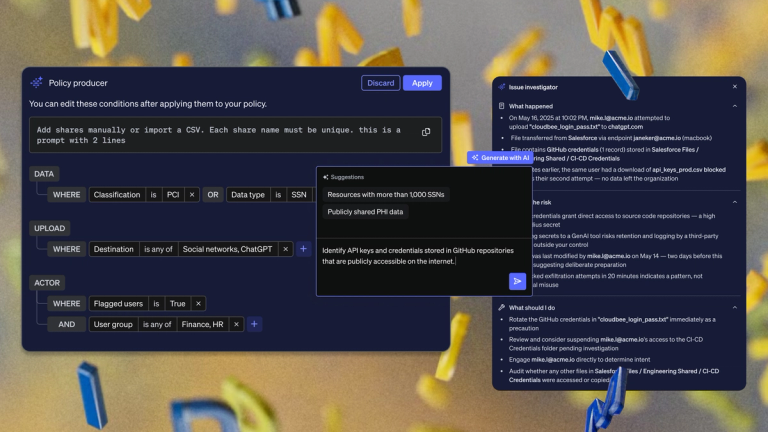
From the beginning, MIND has been built as an AI-native platform. Not AI-enhanced after the fact, but architected around the idea that modern data security requires systems that can reason through context, adapt to changing behaviors and operate at machine speed.
Today, we're extending that foundation.
MIND has been accepted into Anthropic's Cyber Verification Program. We're the first data security company verified. Not the first of several. The first.
The verification gives our platform access to the full range of Claude's capabilities for defensive security research, without the default limitations that apply to general-purpose use.
What is dual-use cybersecurity work?
Some cybersecurity research is considered “dual-use,” meaning the same techniques can be applied defensively or offensively depending on intent.
Threat modeling, adversarial simulation and exfiltration analysis are good examples. Security teams use them to understand how attackers operate, identify weak points and strengthen defenses before incidents occur. Attackers use similar methods to find ways around controls.
Most foundation models apply broad safeguards around these topics by default, which makes sense for general-purpose use. But defensive security platforms still need the ability to study attacker behavior deeply and responsibly if they are going to protect modern environments effectively.
Anthropic's Cyber Verification Program exists to create that distinction. Verified organizations can perform advanced defensive cybersecurity research within a structured and reviewed framework, rather than treating all dual-use work the same.
Why does data loss prevention need unrestricted AI?
Conventional DLP was built on static rules and predictable workflows. Sensitive data got tagged so policies could flag matches against it. That model assumed attackers and insiders behaved within predictable bounds, and it assumed sensitive data lived in predictable places. Neither assumption holds anymore.
Sensitive data now moves through GenAI prompts, agentic workflows and SaaS-to-SaaS integrations at speeds no human reviewer can match. Insider risk looks more like configuration drift than malicious exfiltration. The most useful way to find weaknesses in your own data perimeter is to model how an attacker would probe it.
Doing that work well takes AI cleared to go deep on attacker behavior. It has to study adversarial patterns and simulate how exfiltration actually happens. It also has to trace how insiders move inside the systems they target. Without that clearance, defensive tools see only the surface.
What does Anthropic's Cyber Verification Program actually unlock?
Anthropic's Cyber Verification Program recognizes that some defensive security work requires unrestricted AI capabilities. Verified organizations can apply Claude to a wider range of dual-use cybersecurity tasks, including detailed threat modeling, exfiltration pattern analysis and adversarial simulation, provided that work is grounded in defensive objectives.
For MIND, that means our discovery and classification systems can train on a fuller picture of how sensitive data actually moves and how it's actually targeted. Classification gets sharper because the model understands what attackers value and why. Detection gets more precise because the system can recognize exfiltration patterns it would otherwise be limited from studying.
The verification doesn't loosen safety. Anthropic built it specifically because defensive security has different requirements than other AI use cases, and the program supports that work responsibly.
How MIND is leading the way in safe and effective AI usage
This isn't an isolated milestone. It's part of a broader pattern that reflects how MIND approaches AI.
Earlier this year, MIND became the first data security company to achieve ISO/IEC 42001:2023 certification, the international standard for responsible AI management. That certification governs how we build and operate AI systems. Anthropic's Cyber Verification Program governs what advanced AI capabilities can be responsibly applied to in defensive cybersecurity.
Together, they validate two sides of the same equation: powerful AI systems require disciplined governance, and responsible governance should unlock more capable security outcomes. Two independent assessments, looking at different dimensions of MINDs AI maturity, arrived at the same conclusion about how MIND operates.
Together they represent the equilibrium we've been building toward: responsible governance on one side, advanced defensive capability on the other. That's what it means to be AI-native in security. Not simply embedding AI into workflows, but building the operational discipline, governance and technical depth required to apply AI responsibly at scale.
MIND isn't just running models. We're minding the integrity of your data, with the rigor of certified AI governance behind the work and the depth of verified cyber capability inside it.
That pairing matters because both halves are necessary. Capability without governance is risky. Governance without capability is performative. Our customers deserve both.
What does this mean for MIND customers?
This means continued innovation at the front of what emerging AI models can bring. In practical terms, it will look like classification you can actually trust on challenging data and prevention that engages before a leak becomes an incident. The kind of foresight that turns DLP from a noisy alerting system into something a security team can run on autopilot.
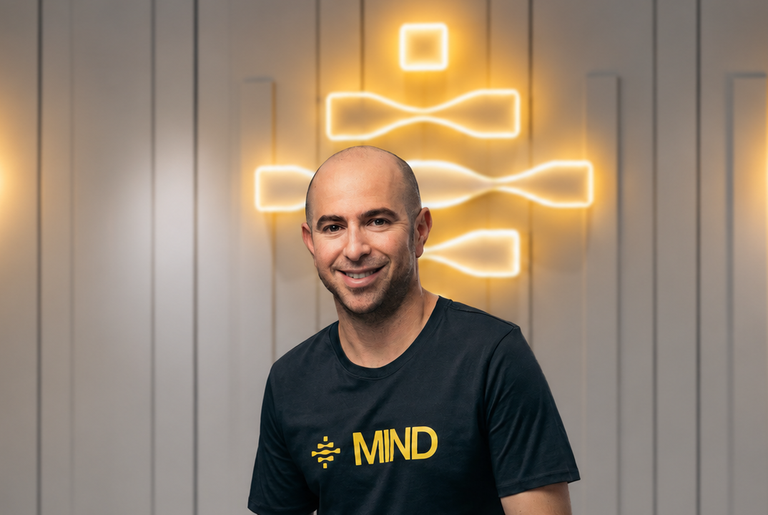
“As an AI-native company, we operate at the cutting edge of what's possible. This verification lets us keep innovating to stay ahead and keep data safe at AI speed.”
Eran Barak
Co-Founder and CEO of MIND
For our customers, the work continues to feel the same: Stress-Free DLP that runs on autopilot. What changes is what we can do underneath and how confidently we can do it.
If you're looking for an AI-native tool to help you secure your sensitive data, MIND seeks to be the most trustworthy option.
You can see for yourself here.