








In today’s data-driven world, sensitive information moves constantly. It flows through SaaS apps, endpoints, cloud storage, collaboration tools and now GenAI platforms.
In today’s data-driven world, sensitive information moves constantly. It flows through SaaS apps, endpoints, cloud storage, collaboration tools and now GenAI platforms.
For security leaders, the challenge isn’t just knowing where data lives. It’s ensuring that data is handled correctly wherever it goes. That’s where Data Loss Prevention policies come in.
DLP policies are the rules that define how sensitive data should be stored, used and moved. When designed and enforced correctly, they help organizations reduce risk, meet compliance requirements and protect what matters most without slowing the business down.
What is a DLP policy?
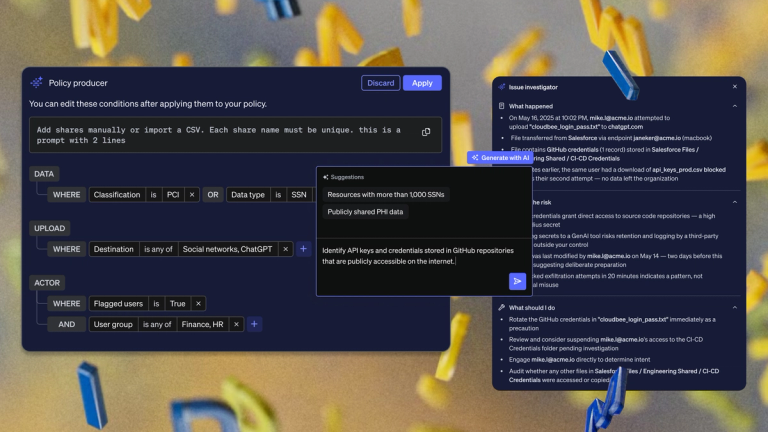
At its core, a DLP policy is a set of conditions and actions. The conditions define what data matters and what risky behavior looks like. The actions define what should happen when that behavior occurs.
A typical policy answers three key questions:
- What type of data are we protecting?
- Where is that data allowed or not allowed to go?
- What action should be taken if the policy is violated?
For example, a policy might state that files containing personal data shouldn’t be shared externally or uploaded to public AI tools. If that action occurs, the policy can trigger an alert, block the action or guide the user with a warning.
How do DLP policies identify sensitive data?
DLP policies can only work if the system understands what data is sensitive in the first place. This starts with data discovery and classification.
Modern DLP platforms scan data across environments to identify sensitive content such as personal information, financial data, credentials or intellectual property. Instead of relying only on simple pattern matching, more advanced approaches analyze context and content to understand meaning.
This step is critical because inaccurate classification leads to false positives or missed risk. When policies are built on a clear understanding of data, enforcement becomes more precise and trustworthy.
How do DLP policies define acceptable data use?
Once sensitive data is identified, DLP policies define how that data can be used. This is where business intent is translated into enforceable rules.
Policies typically focus on common risk scenarios, including:
- Data exfiltration, such as uploading sensitive files to unsanctioned websites or AI tools
- Data exposure, such as sharing files publicly or with the wrong users
- Improper access, such as employees accessing data outside their role
The goal isn’t to lock data down completely, it’s to align protection with business context. Finance teams need different access than engineering. Vendors need different access than employees. Effective DLP policies reflect these realities.
How do DLP policies monitor data in real time?
With policies in place, DLP continuously monitors data activity. This includes data at rest and in motion.
As users share files, send emails, collaborate in SaaS apps or interact with GenAI tools, the system evaluates each action against defined policies. When a risky event is detected, the policy is triggered.
This real-time monitoring is what allows DLP to move from a reactive audit tool to an active security control.
How do DLP policies enforce actions to reduce risk?
Detection alone doesn’t stop data loss. Enforcement is where DLP policies deliver value.
Depending on severity and context, a policy can trigger different responses:
- Blocking the action outright
- Allowing the action with a user justification
- Alerting security teams
- Coaching users with in-the-moment guidance
- Automatically remediating exposure, such as removing public access
The most effective policies use graduated responses. Low-risk behavior might warrant education. High-risk behavior might require immediate prevention. This balance helps protect data while maintaining productivity.
How do DLP policies improve over time?
DLP policies aren’t set-and-forget. As data, tools and workflows evolve, policies must adapt.
Modern platforms use risk signals and behavior patterns to refine enforcement. This reduces noise, cuts down false positives and helps teams focus on what truly matters. Over time, policies become more aligned with how people actually work.
Why do DLP policies matter more than ever?
Traditional DLP often failed because policies were static, noisy and disconnected from context. Today’s environments demand something smarter.
When policies are built on accurate data classification, applied consistently across environments and enforced with context, DLP becomes a strategic asset. It shifts security from reactive compliance to proactive protection.
For CISOs and security leaders, the outcome is confidence. Confidence that sensitive data is protected. Confidence that teams aren’t buried in alerts. Confidence that security enables the business instead of slowing it down.
That’s the real purpose of DLP policies. Not just to check a box, but to mind what matters.