







When the team can't grow, the tools have to ask less of the people already there.
When the team can't grow, the tools have to ask less of the people already there.
Most security leaders already know how this year's hiring plan went. ISACA's State of Cybersecurity 2026 report, published on September 22nd, now puts a number on it. Of more than 1,800 cybersecurity professionals surveyed worldwide, 58% say their team is understaffed. That's up from 55% a year earlier. Almost half have open security roles they still haven't filled.
The people who stayed are carrying the difference. In the same ISACA survey, 68% say their role is more stressful than it was five years ago. High work stress is now the most common reason people leave their jobs, cited by 52%. In fact, I spoke with a CISO last week who mentioned one of their reasons for retiring was how stressful the work had become.
If your team sits inside that 58%, one question about every tool you run gets sharper. How much of your team's week does it quietly take?
Why are security teams still understaffed in 2026?
Budget is the short answer. The ISC2 2025 Cybersecurity Workforce Study found that 33% of respondents' organizations don't have the resources to adequately staff their security teams. Another 29% can't afford to hire people with the skills they need.
ISACA's respondents describe what that looks like from the inside. Unrealistic expectations and too much work came up as a key stressor for 52% of them. More than half struggle to retain qualified people. When someone leaves, their workload lands on whoever's still there.
Data security sits right in the middle of this. ISACA lists it among the biggest technical skills gaps, named by 31% of respondents. The discipline that needs the most specialist care is often the one with the fewest specialists to give it.
What does complex DLP cost an understaffed security team?
Legacy DLP was designed around an assumption most teams can no longer afford. It assumed someone would always be available to write the rules, tune them and review the alerts they produce.
In practice that looks like:
- Rollouts that take months before the first policy is enforced
- Regex and pattern rules that someone has to write and keep current
- Alert queues full of false positives that an analyst clears by hand
- Hard blocks that frustrate employees and push security into the role of blocker
Each of those tasks needs a person. On a team that's already two or three people short, DLP becomes the program that quietly slides. Alerts pile up and policies drift until the team stops trusting the console.
Security leaders are already responding. ISACA found 35% of teams are increasing their reliance on AI or automation to cover technical skills gaps, a 12-point jump on last year. They want tools that carry more of the load themselves.
Why should DLP be simple enough for one person to run?
It doesn't have to be this way. Data security shouldn't need a dedicated team, perfect labeling and months of tuning before it protects anything. Of course you have sensitive data. You're running a business. The goal is to protect it without asking your team for hours it doesn't have.
Simple is one of the three principles MIND is built on, alongside Autonomous and Complete. For a lean team it means deployment in minutes and a program one person can run. It also means employees learn as they work instead of hitting walls.
How does MIND keep DLP simple for lean security teams?
MIND is designed so the platform handles the work that used to need a DLP specialist. It's minding your team's time as much as your data, so the hours you do have go to strategy instead of the alert queue.
Up and running in minutes. You connect your SaaS apps and deploy a lightweight endpoint agent. Insights start arriving within 24 hours. You can turn on prevention from day one. There's no network SSL inspection to set up. At one customer, 20,000 endpoints were deployed in three weeks with zero issues.
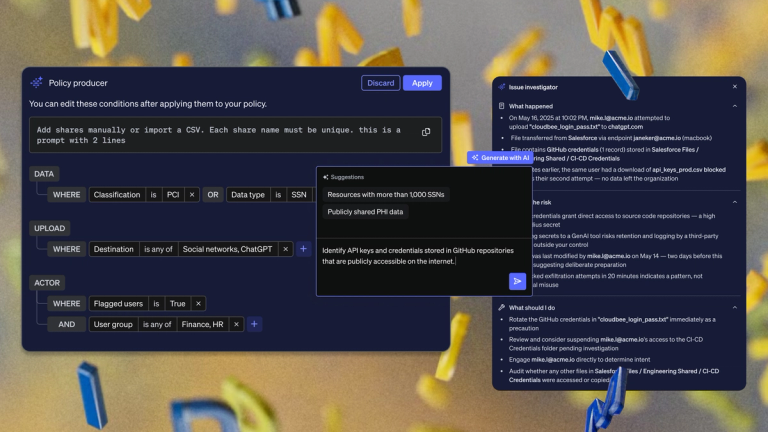
One person can run it. MIND classifies data by content and context, so nobody on your team has to write or maintain regex. Out-of-the-box policies cover the common cases and you can customize them when you need to. The MIND Autonomous Data Security Analyst builds custom classifiers and summarizes each incident. It also takes remediation action where you allow it and escalates where a human should decide. Customers have seen alert volume settle at low double digits per week with near-zero false positives.
Employees learn instead of hitting walls. Adaptive controls let you block, speed bump, coach or monitor based on risk severity. Everyday users get speed bumps and guidance. Blocks are reserved for activity that's actually risky, which keeps people working and keeps security from being seen as the department of no.
The outcome shows up in headcount. At OpenWeb, the security team spends 80% less effort managing its DLP program than it did before MIND. Guild tells a similar story.
“The value that Guild has derived from MIND is we haven't had to build out a full DLP team. Specifically, I didn't need to hire three to four people just to manage MIND.”
Julie Chickillo
VP of Information Security, Guild
What should CISOs ask of their DLP before adding headcount?
If your team is in ISACA's 58%, put a few direct questions to any DLP program, including the one you run today. How long until it enforces its first policy? How many people does it take to keep running? How much of the alert queue turns out to be real?
MIND was built so the first answer is minutes and the second is one person. Book a demo and see Stress-Free DLP working in your own environment on the same day you connect.
Let's mind what matters.