





Some notes from R&D on what we built with the Claude Compliance API and why it matters.
Some notes from R&D on what we built with the Claude Compliance API and why it matters.
A lot of us at MIND use Claude every day. I use it to review code and think through designs. Sometimes I use it to write the first version of a test I don't feel like writing. It's useful because you give it real context about your work. And real context is exactly what makes a security team nervous.
We already protect sensitive data before it reaches Claude. This week we announced our integration with the Claude Compliance API, which gives us a second view from inside Claude itself.
Why is data shared with Claude hard for DLP to understand?
Conversations are messy data. One chat might have a pasted table, part of a contract, some code and a question typed in a hurry. A person reading it understands quickly what's sensitive. A regex rule doesn't.
The example I keep coming back to is a pasted table of prices. It could come from a board deck. It could also come from the public price list on a company's website. The numbers look the same, and the only difference is context, meaning where the data came from and who is sharing it.
If your DLP can't see that context, it will either miss the board deck or alert on every table with a dollar sign. Security teams have lived with that second option for years. It's exhausting, and after a while people stop reading the alerts.
What does the Claude Compliance API give MIND?
Anthropic's Compliance API lets an organization programmatically pull activity events, chat data and file content from its Claude deployments. According to Anthropic's Knowledge Base, coverage also includes Cowork and Claude Code.
For Claude Enterprise customers, MIND ingests conversation content such as chats, uploaded files and projects. We also bring in activity logs and the organization's user directory. For Claude Platform customers, we ingest activity logs.
Setup is simple. An admin enables the Compliance API, creates a scoped API key and connects it to MIND. There's nothing new to install on endpoints for this part, and it's included for MIND customers at no additional cost.
I'll admit the connector itself wasn't the hard part. The interesting engineering is what happens after the data arrives.
How does MIND decide what's sensitive in a Claude conversation?
We use the same multi-layer AI classification engine that runs everywhere else in the platform. It reads the content first and recognizes what kind of data it is, whether that's customer records, a payroll report or source code. Then it adds context from the directory and the activity around it, like who shared the file and which project it sits in.
One detail I like, even though customers never see it, is how we handle repetition. People repeat themselves in Claude. They upload the same file to three different chats or paste the same block again after a small edit. The engine uses exact and locality-sensitive hashing to recognize data it has already classified, so it doesn't spend time on the same content twice.
What we want is simple. When an analyst gets an alert from Claude activity, they should be able to trust it's worth opening.
How does this fit with the Claude controls MIND already has?
Our lightweight endpoint agent and browser extension still sit in front of Claude. When someone tries to paste or upload sensitive data, MIND applies the organization's policy in real time. Depending on the risk, it can block the action, ask the user for a business justification or coach them on the policy.
I still think that's the most important layer, because it's the one that acts before data leaves. The Compliance API adds what the endpoint can't see by design, which is the data already living inside Claude. Having both gives the platform more context than either one has alone.
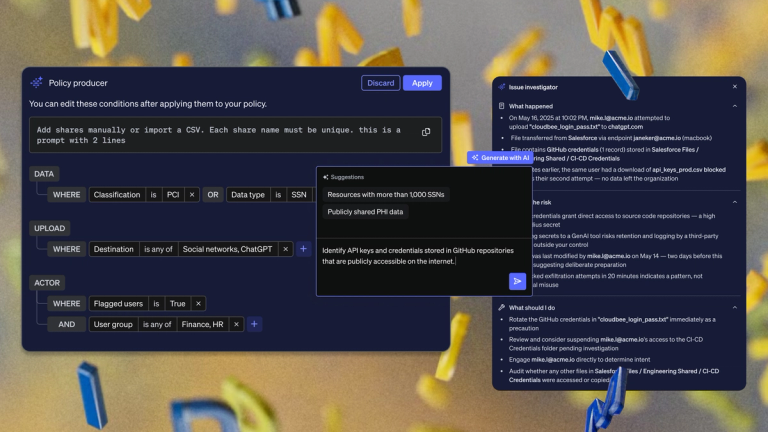
Both layers use the same policies customers already run for SaaS apps, endpoints, on-premise file shares and emails. Findings go to the same MIND workflow the analysts already use, where our AI DLP Agents help investigate issues and suggest remediation.
What changes for the security team?
Less than you might expect, which was the goal. There's no separate policy set for Claude and no new console to learn. Claude just becomes one more environment in the platform.
The part that matters most to me is the noise. MIND customers like OpenWeb have seen up to 80% less DLP program effort and near-zero false positives.
We've worked with Anthropic for a while now. MIND was the first data security company accepted into their Cyber Verification Program, so this felt like a natural next step.
How can you see the MIND and Claude integration on your own data?
If your organization runs Claude Enterprise or Claude Platform, the integration is available now. I'm biased, but I think the best way to judge it is on your own data. Ask our team for a demo and we'll connect it to your environment and show you what it finds.
And if you're an engineer with questions about how any of this works, reach out. Those are my favorite conversations.