





Every vendor sounds autonomous this year. Your alert queue will tell you who actually is.
Every vendor sounds autonomous this year. Your alert queue will tell you who actually is.
At Black Hat earlier this month, one word was everywhere. Agents. Virtualization Review's roundup of the show counted security vendors going agentic across nearly every product category, from the SOC to the endpoint. Gartner saw it coming. Its 2026 Hype Cycle for Security Operations puts AI SOC agents at the Peak of Inflated Expectations, a full phase up from last year. Actual market penetration sits at 1% to 5% of the target audience. The same Gartner report warns buyers about AI washing four separate times. The demand for autonomous security is real. The marketing is ahead of the products. What you need is a way to tell which platforms actually run on AI and which ones just talk about it.
Why does every security vendor suddenly sound autonomous?
Because buyers are exhausted and vendors know it. Microsoft and Omdia's State of the SOC 2026 research shows why. The average organization fields around 1,000 alerts a day. An estimated 46% of them turn out to be false positives and 42% never get investigated at all. Nearly half of an analyst's workload produces no security value, while the alerts that matter wait behind the ones that don't. No team hires its way out of that arithmetic. No security leader still believes the next tuning cycle will fix it. Autonomy is the only answer that scales, which is why it's now on every slide.
Gartner's caution is about what's actually shipping. The firm predicts more than 40% of agentic AI projects will be canceled by the end of 2027. The reasons it cites are escalating costs, unclear business value and inadequate risk controls. Our own research shows where the failures have already started. In MIND's study with CISO Executive Network, a survey of 124 security leaders, only 1 in 5 AI projects met their intended KPIs. The primary cause was insufficient classification, unscanned storage and ungoverned access, the condition of the data rather than the quality of the models. Much of what's being sold as agentic this year is pre-AI architecture with a language model bolted on.
What does AI-washing look like in a data security platform?
It looks like the regex engine you already own, now with a chat window. An LLM summarizing alerts from a detection layer that misfires half the time just delivers the noise faster. A policy copilot that drafts rules your team still has to tune, test and babysit hasn't removed the work. It has relocated the work. And none of it repairs the unclassified, ungoverned data layer where the CISOs in MIND's research watched their AI projects miss their KPIs.
The test is simple to state. Follow the labor. If your team still writes detection rules, still labels data by hand and still reviews every alert because none can be trusted on its own, the AI in the product is decoration. The architecture underneath is doing what it did in 2019, whatever the booth said in August. And a stretched team pays for that gap twice, once in the license and again in the hours the "autonomous" platform quietly hands back to them.
How can you tell a platform is AI-native?
Ask what the AI does when nobody is helping it.
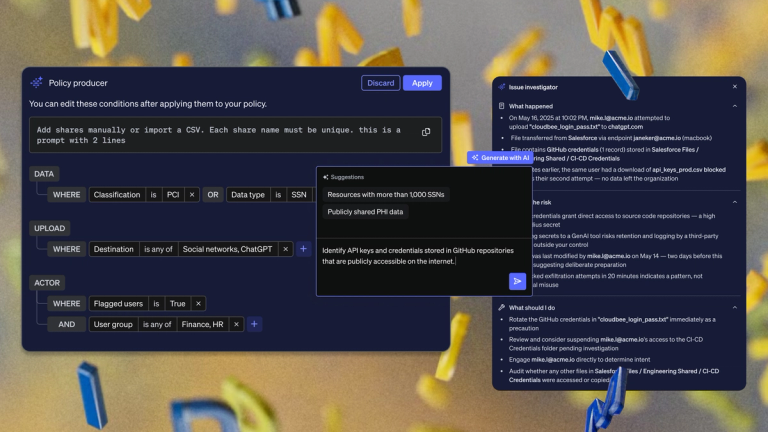
MIND was built around AI from day one. The difference shows up in who does the work. Classification reads content and context together, so the system recognizes that a file is a payroll report or a board minute instead of pattern-matching its way to another false positive. Sitting above that classification layer is the Autonomous Data Security Analyst. The Custom Classifier builds the data classifiers your team would otherwise write by hand. The Issue Investigator summarizes each incident, surfaces the pattern behind it and explains what's happening. The Policy Producer authors and refines policies from observed behavior and plain-language input. The Risk Remediator takes action where it's allowed and escalates where it isn't.
Beyond automating DLP tasks, MIND is minding the judgment work that kept your analysts chained to a queue. Autonomy done right means fewer decisions land on a human at all.
The outcomes are the proof. Customers report near-zero false positives, alert triage cut from hours or days to minutes and weekly alert volumes that stabilize in the low double digits with far higher fidelity.
“When an alert comes from MIND, we know for a fact it's worth following up on. That's hugely valuable.”
Richard Reinders
VP of Information Security, Gravity Payments
That sentence is the whole evaluation, compressed. Trust in the alert is what autonomy is for.
How should you evaluate autonomy claims this year?
Gartner's advice for buyers at the peak of the hype cycle is to pilot rigorously and verify claims before paying a premium. We'd sharpen it. Don't evaluate the demo, evaluate day one. MIND deploys in minutes and delivers insights within the first 24 hours, so a proof of value answers the AI-native question in your own environment almost immediately. What we demo is what you get. At the peak of the hype, that's the only kind of claim worth anything.
If the agentic pitches from Black Hat are still ringing in your ears, put one to the test. Book a demo and judge the autonomy by what it does without you.