






AI adoption made the alert queue louder, and the alerts about sensitive data leaving got harder to hear.
AI adoption made the alert queue louder, and the alerts about sensitive data leaving got harder to hear.
AI-related security alerts grew 685% between February and June 2026. The figure comes from Intezer, an AI SOC vendor that reviewed roughly 16.9 million enterprise alerts and published its findings in The Hacker News. The Cloud Security Alliance analyzed the research in a September research note and reached a sober conclusion. Legacy detection logic can't tell routine AI use apart from risky activity, so real signal is getting buried under a fast-growing pile of noise.
If you lead a security program, that probably matches what your team sees on a Monday morning. Developers run coding agents. Finance has a chatbot. Someone in sales just connected a new AI app to the CRM. Each one leaves a trail. Most of that trail lands in your queue.
Why are AI tools flooding security teams with false positives?
Intezer sorted every AI-related alert into three buckets. According to its analysis, 94.1% were noise from legitimate developer and business work. Another 5.8% were genuine risk. Only 0.02% were confirmed attacks.
The noise has a clear cause. Detection rules written before AI agents existed see an agent installing packages or spawning a shell and read it as the early stage of an intrusion. Intezer found the genuine Claude Desktop installer tripping ransomware rules at several customers.
AI didn't invent alert fatigue. Research from Microsoft and Omdia found that 46% of SOC alerts prove to be false positives and 42% go uninvestigated. AI adoption has piled a fast-growing new category on top of a queue that was already overflowing.
What sits inside the 5.8% of AI alerts that carry real risk?
This is the slice worth your attention. Much of it is about data. Intezer calls it the quiet half of AI adoption. Employees grant OAuth consent to third-party AI apps and paste documents into GenAI tools. In Intezer's words, it rarely trips an endpoint detection, "but it is where data leaves the building."
Other risks in the slice involve coding agents running with their permission safeguards switched off or opening tunnels to the public internet. Those sit with endpoint and identity teams. The data question is narrower and familiar to anyone who has run DLP. Was the data that left sensitive, and should it have gone there?
Why doesn't automated suppression fix AI alert fatigue?
Teams already lean on automation to cope. Intezer found that 81.7% of AI-related alerts were closed automatically with no analyst review. Only 5.4% ever reached a human.
Some suppression is unavoidable at this volume. The CSA note names the catch. Suppression built to cut volume, rather than to tell the 0.02% apart from the 94.1%, risks discarding the rare true positive along with the noise it resembles.
So the useful question for any automation in data security is whether it understands what it's looking at. Pattern matching can be tuned louder or quieter. It still can't tell a board deck pasted into a chatbot from a public press release with the same keywords.
How does autonomous DLP separate real data risk from AI noise?
You don't have to choose between drowning in alerts and switching them off. The other path is a system that makes the judgment itself, with enough context to get it right.
At MIND, Autonomous starts with classification. It's multi-layer classification by content and context. It goes well beyond regex. MIND recognizes contracts, medical records, payroll reports, board minutes, source code and more. It then weighs what the data is doing and who's moving it. A developer's agent pulling packages stops looking like a leak. A customer list pasted into a chatbot stops looking like routine work.
Underneath sits the MIND Autonomous Data Security Analyst, which handles the work a DLP team used to do by hand:
- Custom Classifier builds the classifiers your team would otherwise write manually.
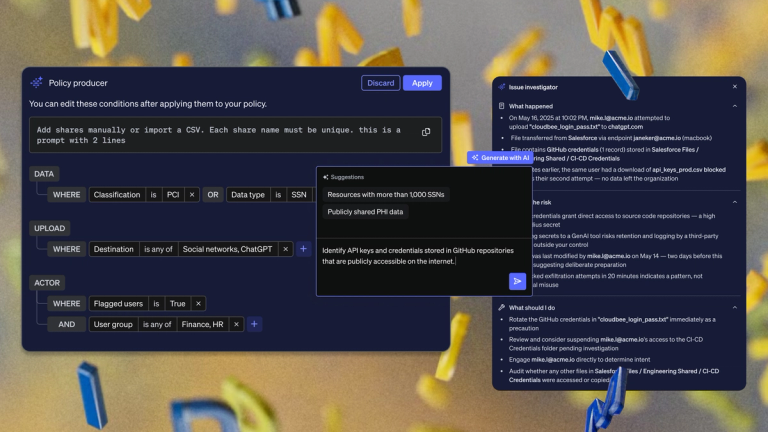
- Issue Investigator summarizes each risk, surfaces patterns and explains what's happening.
- Policy Producer authors and refines policies from observed behavior and natural-language input.
- Risk Remediator takes action where allowed and escalates where needed.
When something does need stopping, controls match the risk. MIND can block, add a speed bump, coach the user or monitor, in real time on the endpoint and in the browser. Most people get guidance in the moment. Blocks are kept for actual risky activity.
Those controls extend to AI agents acting on behalf of people. An agentic tool works inside the same data boundaries as the person who launched it, so your team can say yes to the next AI rollout with some foresight. MIND keeps minding what your data is doing, which frees your analysts from watching every agent.
What does a quieter DLP queue look like in practice?
MIND customers report near-zero false positives, with alerts stabilized to low double digits per week. Alert triage drops from hours or days to minutes, because the alerts that remain are the ones that matter.
“When an alert comes from MIND, we know for a fact it's worth following up on. That's hugely valuable.”
Richard Reinders
VP of Information Security, Gravity Payments
How can you see autonomous DLP in your own environment?
AI alerts are still a small share of the queue. Their volume grows every month. Intezer warns that a team sizing its AI alert handling to today's volume will be under-provisioned within a quarter.
Book a demo and watch MIND discover, detect and prevent in your environment within minutes. DLP on Autopilot, with the judgment built in.
Let's mind what matters.