






When the secure route is the slow one, people find another way to get their work done.
When the secure route is the slow one, people find another way to get their work done.
Most companies have already written their AI rules. In a Zapier survey of 548 US directors, VPs and C-suite executives at companies with 500 or more employees, 91% said their organization has AI governance policies in place. Nearly four in five also said their employees actively bypass or work around those processes to get AI workflows live faster.
Twenty-eight percent of the same executives told Zapier their formal policies exist on paper but aren't consistently enforced across teams or use cases.
If you lead security, you've probably watched this play out. A policy says one thing. A deadline says another. The deadline usually wins. Sensitive data then goes wherever the deadline sends it.
Why do employees work around security controls and AI policies?
It's rarely malice. TeamViewer's Digital Friction Report found that 40% of employees worldwide have used personal devices or apps as a workaround when work technology fails. Patricia Leppert of TeamViewer described the research in IT Brief Asia. The same study found 80% of people lose time to broken IT, about 1.3 workdays a month on average.
The Zapier data points the same way. In that survey 41% of executives said their organization's primary approach is to move fast and refine governance as they go, even if it risks compliance. Another 47% said they hold off on deployment until governance and testing are locked in. When leadership splits almost evenly, employees tend to pick the side that lets them ship.
Most people aren't trying to leak anything. They want to finish a board report or answer a customer before Friday. If the approved path takes three approvals and a ticket, a personal AI account starts to look reasonable. So does a file-sharing app nobody in security has heard of.
What happens to sensitive data when DLP creates friction?
The data goes with the workaround. A contract pasted into an unapproved chatbot now sits outside every control your team configured. So does a customer list uploaded to a personal drive. Leppert makes the point in her piece for TeamViewer. When security friction pushes work into unmanaged environments, the business can end up less secure than before.
Legacy DLP tends to make this worse in two ways.
First, rules written as regex patterns fire on harmless content. Users hit blocks for files that were never risky. Every false block teaches them the tool is in the way. Second, the security team spends its week reviewing alerts that don't matter. Exceptions pile up until enforcement gets softened for whole departments, often the ones handling the most sensitive data.
The result is a program that looks strict on paper and leaks in practice. Your team carries the stress of both. You answer for the policy and you also answer for the gaps around it.
How does simple DLP keep employees on the safe path?
It doesn't have to be this way. Of course your people handle sensitive data. They're running the business. The goal is controls that fit how that work happens, so the secure route is also the easy one.
MIND's Simple pillar starts from that idea. In practice it looks like this:
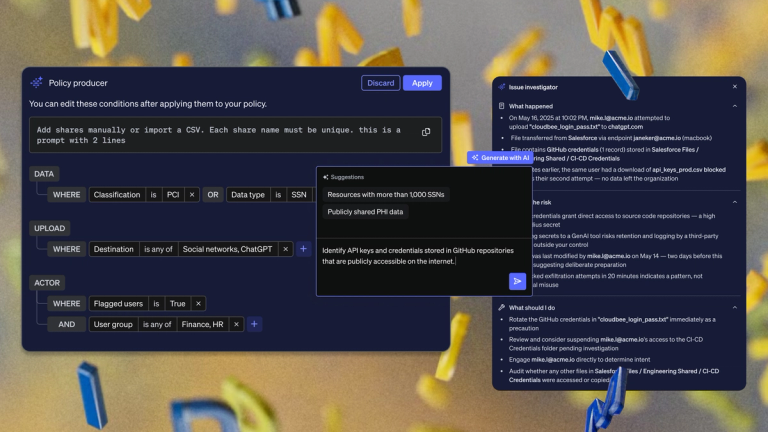
- Guidance before blocks. MIND's adaptive controls block, speed bump, coach or monitor based on risk severity. Everyday users get a speed bump and guidance in the moment. Hard blocks are kept for activity that's actually risky.
- Accurate classification, so interruptions are earned. Multi-layer AI classification reads content and context, beyond regex. Fewer false positives mean fewer pointless prompts for the people doing the work.
- Prevention where the work happens. Real-time controls run on the endpoint and in the browser across Windows, Mac and Linux. There's no network SSL inspection and no latency tax.
- One person can run it. There's no dedicated DLP team to hire and no PhD in regex required. Deployment takes minutes, with insights inside 24 hours.
Picture an analyst about to paste customer records into an AI tool your company hasn't approved. A speed bump pauses the action and tells them why before the data leaves. Most people take the hint and carry on with the sanctioned option. The few who push past it are the events your team should see.
MIND is minding that moment of choice for you. Your team gets to focus on the handful of decisions that carry real risk, while everyone else keeps working without hunting for a side door.
What does simple DLP change for a lean security team?
Fewer false blocks mean fewer exceptions to manage and fewer users looking for a way around. They also mean fewer hours spent explaining to a frustrated department why their upload failed.
The bigger change is headcount. When the platform handles classification and prioritization, the program no longer needs a specialist team to keep it running. Julie Chickillo, VP of Information Security at Guild, described what that meant for her organization.
“The value that Guild has derived from MIND is we haven't had to build out a full DLP team. Specifically, I didn't need to hire three to four people just to manage MIND.”
Julie Chickillo
VP of Information Security, Guild
That headroom matters when your AI policies already outnumber the people available to enforce them. Your analysts can spend the week on alerts that point to real risk. Your employees get guidance that helps them finish the task safely instead of a wall that pushes them toward a personal account.
How do you know if your DLP is pushing people toward workarounds?
A few signals tend to show up first. Business teams ask for blanket exceptions instead of specific ones. Your analysts close most DLP alerts without action. Employees describe the tool as something to get around rather than something that helps. Each one suggests the secure path has become harder than the alternative.
Your policies are already written. The next step is making the secure path easy enough that people choose it. Book a demo to see MIND running in your environment within minutes, with prevention you can turn on from the first day. That's Stress-Free DLP.