








A worm that harvests credentials is a data loss event, and most programs won't see it.
A worm that harvests credentials is a data loss event, and most programs won't see it.
On August 4, someone compromised the GitHub account of the maintainer behind keyv, a key storage library with roughly 127 million weekly downloads. Within four hours, SecurityWeek reported, 2,212 malicious package versions had been published to the npm registry. The campaign, named ChainDrop, went on to infect more than 400 packages. Infosecurity Magazine put the combined install base at two billion downloads a month. Packages tied to Deliveroo and Qlik were among the casualties.
Most of the coverage has framed this as a software supply chain story. It is one. It's also a data exfiltration story. That's the part security teams are underweighting.
What did the ChainDrop worm actually steal?
Credentials, and it wasn't picky about which. According to Microsoft Threat Intelligence's analysis, the malware runs through an npm preinstall hook before installation even completes. From there it searches developer workstations and CI/CD environments for npm and GitHub tokens along with cloud and infrastructure credentials. It authenticates to AWS, Kubernetes and HashiCorp Vault with what it finds. Then it reads workflow secrets and secret store values. Infosecurity Magazine adds Stripe and Slack tokens to the haul, plus a general file system scan.
Then the worm encrypts everything it took and ships it out, either to a dynamic HTTPS endpoint or to public GitHub repositories carrying the description "Shai-Hulud: Here We Go Again."
Read that sequence again from a data security perspective rather than an AppSec one. Sensitive data was located wherever it happened to be sitting. Then it was encrypted and moved to an external destination. Strip away the npm packaging and that's the shape of a data loss event, whatever the initial access looked like. It happened on laptops and build runners, in seconds, with no human clicking anything.
Why don't most DLP programs see credential theft?
Because most were built around a narrower idea of what counts as sensitive. Customer records, payment data, contracts. Those matter. But a Vault token or an AWS key sitting in a config file on a developer's laptop is arguably worth more to an attacker than any single document, because it unlocks everything the document lives next to.
The reason is mostly classification. Legacy detection is pattern based, so a secret embedded in a config file, a runbook or a code snippet often doesn't match anything the tool was told to look for. A rule written for card numbers has nothing to say about a Vault token.
As Katie-Paxton Fear of Semgrep told Infosecurity Magazine, organizations can't assume they're safe just because they weren't using the package. Any installation should be treated as a possible credential breach.
Where else are your secrets sitting right now?
No data security tool was going to stop a preinstall hook executing arbitrary code on a build runner. Rotating tokens, rebuilding CI and auditing repositories is the right response. It's also the only response for the credentials the worm actually reached.
The question that outlasts the incident is the one about copies. Tokens get pasted into Slack threads during an outage. Keys get attached to a Jira ticket so a colleague can reproduce a bug. Connection strings land in Confluence runbooks and shared drives, and they sit there long after whoever posted them moved teams. Those copies are data at rest, in systems you can inventory on your own schedule rather than an attacker's.
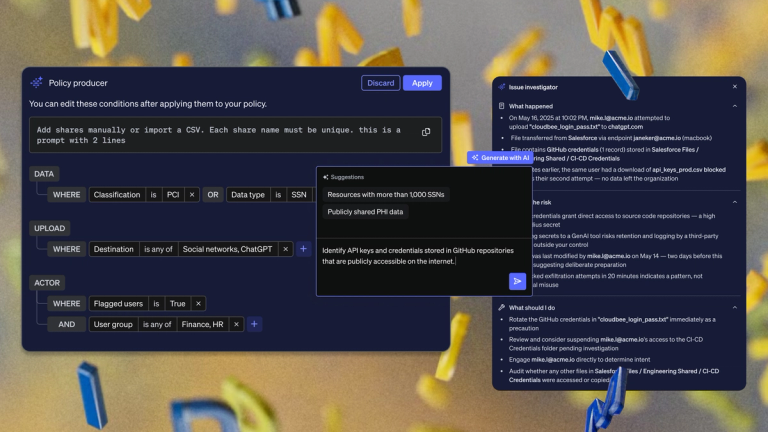
That's where MIND does its work. MIND continuously discovers and classifies data at rest across SaaS apps, on-premise file shares and email, building a living inventory of resources, users and activity. Classification reads content together with context, so a configuration file or a key pasted into a document gets recognized without anyone writing a rule for it first. On the endpoint, MIND works on data in motion, with prevention running at the endpoint and in the browser rather than in the network path. Beyond cataloging files, MIND is minding where your secrets have quietly accumulated, so the blast radius question doesn't wait on an incident to get asked.
“MIND was 100% accurate in finding sensitive data in our cloud storage, compared to our previous DLP tool.”
Mike Morrato
CISO & Global Head of IT, Noname Security
ChainDrop self-clears after 24 hours, according to the researcher reporting SecurityWeek cites, so the evidence window closes fast and the exposure question lands before anyone is ready for it. Teams are rotating credentials this week. The harder question is the one after that. Do you know how many copies of those same secrets are sitting in your SaaS apps and file shares right now? See what a complete data catalog looks like in your environment. Stress Free DLP starts with knowing what you have.