






The longer security takes to deploy, the more the business routes around it.
The longer security takes to deploy, the more the business routes around it.
Eight days. That's the average delay that security-driven network changes now add to an AI deployment, according to NetFoundry's 2026 State of Secure AI Access survey. More than half of the CISOs and CTOs surveyed said those changes add one to two weeks to every rollout. The business isn't waiting that long. In the same survey, 90% of leaders said they're worried about employees adopting AI tools without oversight from IT or security. Read the two findings together and the problem sharpens. When the approved path takes weeks, people find an unapproved one. Security friction doesn't stop AI adoption. It pushes adoption somewhere you can't see it.
Why has security review become the slowest step in AI adoption?
The delay isn't carelessness. Every new AI model, API or data connection deserves review before it touches sensitive data. The question is what that review costs when the tooling behind it was designed for a slower world.
Legacy DLP asks for months of rollout before the first policy fires. It asks for regex libraries someone has to write and tune by hand. Then it assumes a dedicated team will watch the alert queue. The people to staff that team are getting harder to find. In the 2026 State of Cloud Security Report from Cybersecurity Insiders, sponsored by Fortinet, 74% of the 1,163 security professionals surveyed reported an active shortage of qualified cybersecurity staff.
So each AI request lands on a team that's already stretched, holding tools that need care and feeding just to stand still. NetFoundry's survey found that only 15% of security and technology leaders are very confident their existing tools can adequately protect AI deployments. The review takes eight days because everything underneath it takes eight days.
What does simple data security look like in practice?
It doesn't have to work this way. Most of what makes a security review slow is the manual effort the tooling demands. Remove the effort and the review shrinks with it.
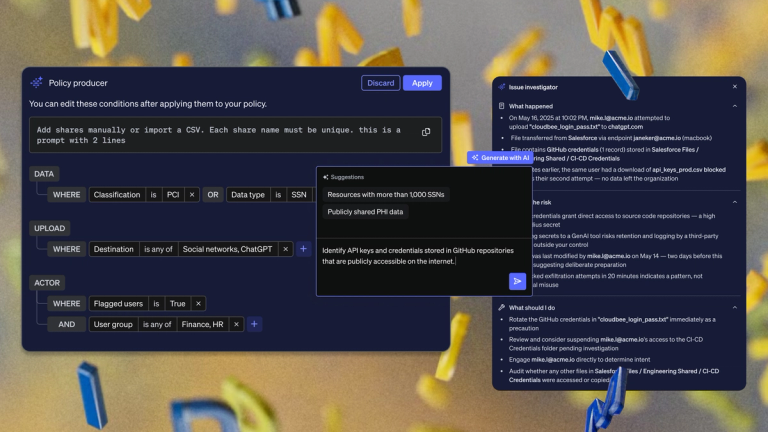
MIND was built around that idea. It shows first in deployment. You connect your SaaS apps and roll out a lightweight endpoint agent with a browser extension. There's no SSL break-and-inspect to stand up and no months-long rollout plan to manage. Michael Alegre, Director of IT Operations at Guild, described what that felt like.
“To deploy MIND, from the minute it was stood up, it took minutes, literally minutes.”
Michael Alegre
Director of IT Operations, Guild
From connection, insights arrive within 24 hours and prevention can be switched on from day one. The pattern holds at scale. MIND has deployed 20,000 endpoints in three weeks with zero issues and now runs on over 100,000 endpoints across customers with zero operational issues.
How does simple data security change what your team carries?
Deployment speed is the visible half of simple. The heavier half is who runs the program on day 200.
With legacy tooling the answer is a dedicated DLP team. With MIND, one person can run it. Classification works from content and context rather than hand-tuned patterns, so nobody needs a PhD in regex. Policies ship with out-of-the-box defaults that you can customize when your environment calls for it. Julie Chickillo, VP of Information Security at Guild, put a number on what that removes.
“The value that Guild has derived from MIND is we haven't had to build out a full DLP team. Specifically, I didn't need to hire three to four people just to manage MIND.”
Julie Chickillo
VP of Information Security, Guild
Simplicity reaches end users too. Instead of silent blocks people learn to route around, MIND educates in the moment. Everyday activity gets speed bumps and guidance. Hard blocks are reserved for the actions that carry real risk. Friction people understand is friction they'll accept.
The platform takes on the review work itself, minding the gap between how fast your business adopts AI and how fast your team can approve it. That frees the team for the work that needs human judgment.
What could your team do with those eight days back?
Go back to the eight days. Multiply them by every model, integration and agent your business will want to connect this year. The real cost of complex security shows up in delayed projects and shadow adoption rather than in line items.
It adds up differently when the platform underneath the review deploys in minutes, runs without a dedicated team and answers with near-zero false positives. The review stops being the long pole. Security gets to say yes at the speed the business asks.
The fastest way to test any of this is to watch it in your environment. Book a demo and see value the same day you connect. That's Stress-Free DLP.
Let's mind what matters.