






Your security stack was built to watch people. The fastest-growing users of your data are no longer people.
Your security stack was built to watch people. The fastest-growing users of your data are no longer people.
Only 15% of security leaders say they're very confident their existing tools can protect AI deployments. The number comes from NetFoundry's 2026 State of Secure AI Access survey of 200 CISOs and CTOs, released this month. The same leaders expect AI to expand their attack surface by an average of 14% over the next year. Nearly all of them report limited visibility into their own AI deployments. Put the findings side by side and the problem takes shape. The business keeps onboarding a new kind of worker, an AI agent with credentials and a task list. Every tool watching your data was built for the old kind, the one with a badge, a personality and a manager.
How much of your data can AI agents actually reach?
More than anyone approved, according to research published this summer. 1Password surveyed 1,000 security and engineering staff at large US firms in May and June 2026. In that group, 46% of developers already run AI agents in production. 71% said their agents can reach sensitive information. The detail worth a second read sits underneath. Agents touched roughly twice as much data as anyone had signed off on. At about four in ten organizations, agents reach data outside their approval entirely.
Access also outlives the work. 40% of developers grant agents persistent access to systems and secrets, so the doors stay open after the task ends. Among developers who use agents, 33% said their company has already had a breach or security incident tied to overprivileged non-human identities.
The pattern holds beyond one study. In a Cloud Security Alliance survey, 53% of organizations said their AI agents exceed intended permissions occasionally or sometimes. 47% report a security incident involving an AI agent. For 58%, detection and response takes five hours or longer. An agent operates with human-level permissions at machine speed. Five hours is a long time at that speed.
Why can't legacy DLP or DSPM follow an AI agent?
The tools didn't get worse, rather the underlying model they relied on has expired. Legacy DLP watches data in motion through known channels like email and the endpoint. DSPM maps data at rest and scores your posture. Each covers a slice of the problem. An agent's working day cuts across all of it. It authenticates like a service account, reads like an employee and writes like an integration.
The visibility numbers say the same thing. In the NetFoundry survey, organizations report less confidence securing AI systems and machine workloads than protecting human users. More than a third of leaders struggle to monitor AI agent activity at all. Ninety percent are concerned about employees using AI tools without the approval or oversight of IT and security. A decade of security investment went to people and the ways people touch data. The fastest-growing activity on that data now comes from software.
It doesn't have to be this way. Buying one more point tool for one more channel repeats the pattern that created the gap. Agents don't respect the boundaries between your tools. Your data security can't afford to keep them.
What does complete data security look like in the agent era?
Complete data security means one platform that discovers, detects and prevents in one place, instead of separate products stitched together after the fact. DLP that covers some channels is DLP with a blind spot. The agent era is the hardest test that requirement has faced.
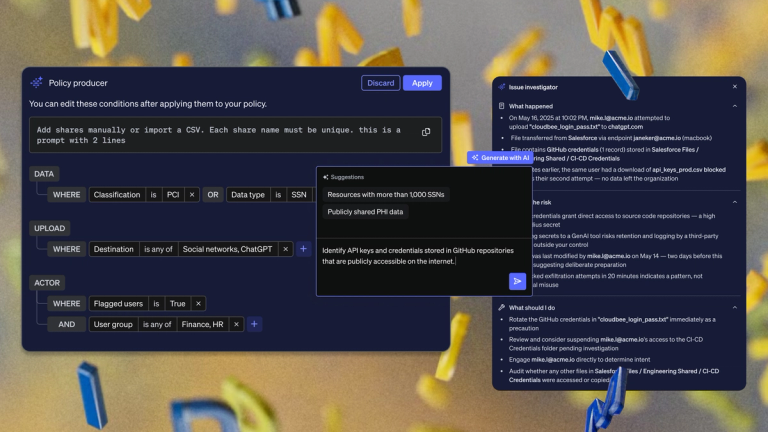
MIND discovers and classifies sensitive data everywhere it lives, across SaaS apps, on-premise file shares, endpoints, email and AI tools. It covers data at rest and data in motion from the same architecture. That distinction matters more than it did a year ago. DSPM tells you about rest. DLP acts on motion. An agent moves between those states constantly, so a control that sees one of them sees a fraction of the agent's day.
Identity is the other half. MIND ties who or what is touching data to what that data is. The same controls extend to agentic AI identities, so when your finance team deploys an agent, its data exposure gets the same boundaries as a person's. MIND goes beyond inventorying which agents exist. It's minding the data they touch as it sits and as it moves. Prevention runs in real time at the endpoint and in the browser, which is how one customer stopped sensitive data from being pasted from Slack into ChatGPT as it happened.
None of this asks you to rip anything out. MIND complements the security stack you already run. Existing data labels and Purview deployments get smarter.
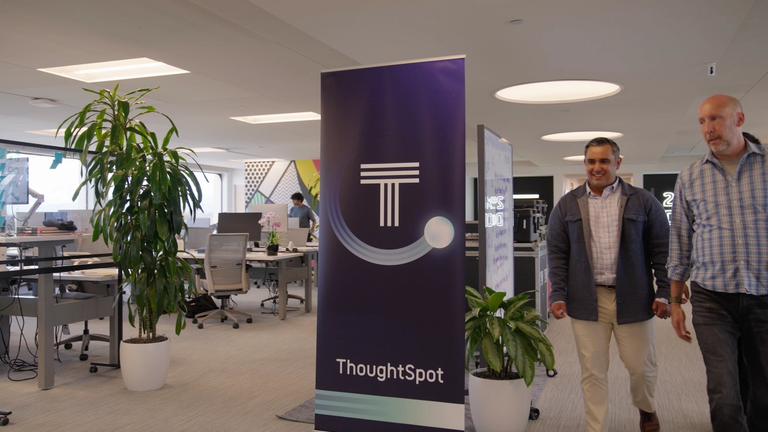
“MIND allows us to see and protect our data across every vector, endpoints and SaaS, from a single place. It's like having a spotlight that shines where visibility didn't exist before.”
Al Faiella
Senior Director of Security Engineering, ThoughtSpot
Agent adoption isn't slowing down while security catches up. If agents already read more of your data than anyone approved, the first step is seeing it as it happens. MIND gives you one platform covering every environment and every state of your data, with the same boundaries for agents as for people. That's DLP at AI Speed. Book a demo and see what your agents are actually touching.