






A security gap stays open when fixing it takes more hands than the team has.
A security gap stays open when fixing it takes more hands than the team has.
Most security leaders can name the gap they'd close first, but closing it takes hours they don't have. CyberFOX's Security Maturity Index surveyed 361 IT and security leaders at organizations with fewer than 5,000 employees. It found that 62% say limited staffing has left important security risks unaddressed. Another 46% say their most significant known gap has been open for at least six months. CyberFOX commissioned the research and TrendCandy conducted it, so treat it as a data point rather than census.
But this signal matches the reality we hear from security leaders every day. The team knows where problems lie, but the hours to fix it keep going to something else.
Why do known security gaps stay open for six months?
Capacity is the usual answer. The numbers back it up. CyberFOX found that 37% of organizations with 15 to 50 IT staff still report unresolved security risks tied to limited staffing. Among teams of fewer than 15 the figure was 81%, according to ChannelBuzz's coverage of the research.
A second survey points the same way. Barracuda's Cybersecurity Skills Gap Report polled 2,000 IT and security decision-makers at organizations with 100 to 2,000 employees through Arlington Research. Some 94% reported skills gaps. Half said their security professionals are expected to support growing digital operations without additional resources. Two in three (67%) said their teams are struggling to scale. Nearly a third (32%) can protect the business only reactively.
The workload keeps growing too. CyberFOX found that 77% of respondents let employees use generative AI tools for work while only 16% have comprehensive AI policies. Each new tool puts more data in more places.
What happens to DLP when nobody has spare hours?
Data security is ongoing work. Someone has to build classifiers for the data that matters to your business. Someone has to write policies and keep tuning them. Someone has to review the alerts those policies generate. Each exception needs a decision. Legacy tools tend to demand that attention constantly and return a steady stream of false positives for the team to sort through.
On a stretched team the program slows down. Policies age while alerts wait for review. The gap that was supposed to close next quarter is still open the quarter after.
You might feel like the only answer is another hire. Many security leaders have felt the same way. What they found is that expectations keep rising without extra resources, as half of the Barracuda respondents said. Headcount isn't the only way to gain scale. Technology can do the repetitive work, so the same team covers more data without more hours.
Data security is the place to look for that scale first. Every other control rests on knowing what your data is and where it lives, especially as AI starts using it. A program that needs a specialist at every step puts that foundation on the thinnest part of the team. Buying another tool rarely helps if it needs a full-time owner. A security leader with a small team can't absorb one more console.
What does simple DLP look like in practice?
It starts with a platform that carries the routine work. For MIND, that is the Simple principle in practice.
Deployment takes minutes. You connect your SaaS apps and deploy the endpoint agent, then start seeing value the same day. One person can run it, with no dedicated DLP team.
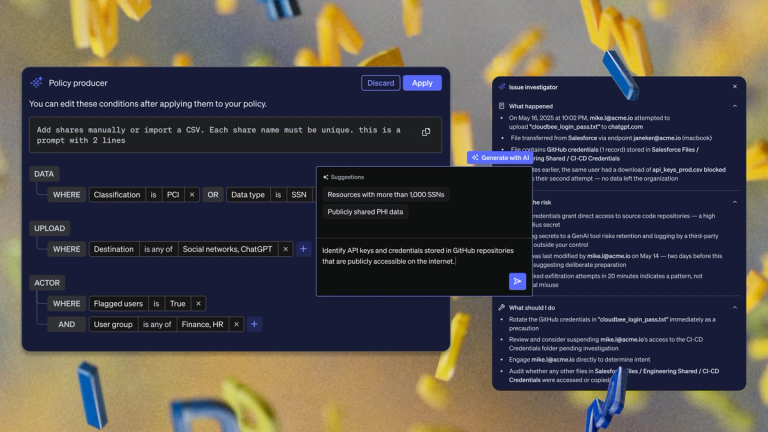
The routine work belongs to the MIND AI DLP Agents. The Custom Classifier Agent builds business-specific classifiers. The Policy Producer Agent writes and refines policies from observed behavior and plain-language instructions. The Issue Investigator Agent analyzes incidents and explains the risk. It also suggests what to do next. The Rapid Response Agent carries out remediation and escalates when a human needs to approve it.
End users get guided rather than blocked. Controls adapt to risk severity, so an everyday mistake gets a speed bump or a coaching prompt. Blocks are saved for real risk.
The aim is to mind the routine work so your team's hours go to the gaps that have been open too long. Classification reads content and context rather than relying on regex alone. Detection is risk-based, so it surfaces what actually matters instead of everything that triggers a rule.
“The value that Guild has derived from MIND is we haven't had to build out a full DLP team. Specifically, I didn't need to hire three to four people just to manage MIND.”
Julie Chickillo
VP of Information Security, Guild
How can you tell whether your DLP is simple enough?
Four questions help:
- Can one person run it without a dedicated DLP team?
- Does deployment take minutes instead of weeks?
- Does the platform analyze incidents and explain the risk without your team?
- Does the platform refine classifiers and policies over time without your team?
If the honest answer to most of these is your team, the tool is competing for the same hours as the gaps it was bought to close. Those hours are what CyberFOX and Barracuda found missing.
MIND is built so one person can run DLP on Autopilot. Book a demo to see it in your own environment and watch value show up the same day you connect. Let's mind what matters.