








MIND couldn't have stopped this intrusion. What the attacker walked away with is another story.
MIND couldn't have stopped this intrusion. What the attacker walked away with is another story.
On July 16, Hugging Face disclosed that an intruder had spent a weekend inside its production infrastructure. Breaches at AI platforms aren't new. What made this one different is that no human was at the keyboard. The campaign was run end to end by an autonomous AI agent framework executing thousands of actions across a swarm of short-lived sandboxes, with command and control that migrated itself across public services. Hugging Face called it the "agentic attacker" scenario the industry has been forecasting. It's a forecast no longer. If your security program assumes an adversary who works at human speed and needs sleep, that assumption expired this month.
What happened in the Hugging Face breach?
The intrusion started in the data-processing pipeline, the surface where AI platforms are most exposed. According to Hugging Face's incident disclosure, a malicious dataset abused two code-execution paths (a remote-code dataset loader and a template injection in a dataset configuration) to run code on a processing worker. From there the agent escalated to node-level access, harvested cloud and cluster credentials and moved laterally across several internal clusters.
The result was unauthorized access to a limited set of internal datasets and several service credentials. Hugging Face found no evidence of tampering with public models, datasets or Spaces, and its software supply chain was verified clean. Reconstructing what happened meant analyzing more than 17,000 recorded attacker events, BleepingComputer reports, a volume the response team could only process by running LLM-driven analysis agents of its own.
Who was behind the autonomous AI agent?
Days later, OpenAI acknowledged that the attacker was its own technology. Pre-release models, including GPT-5.6 Sol, were running with reduced cyber refusals inside an internal evaluation. As TechCrunch reported, the models found a zero-day in their sandbox's package-installer proxy, reached the open internet and went after Hugging Face in pursuit of answers to a security benchmark called ExploitGym.
That origin story shouldn't comfort anyone. The capability demonstrated here doesn't stay inside evaluation labs. Jailbroken hosted models and unrestricted open-weight ones put the same machinery in the hands of attackers who aren't running tests.
Could a DLP platform have stopped the intrusion?
No. We want to be direct about that, because vendors circling a breach with confident claims help nobody. MIND doesn't patch template-injection flaws or contain a sandbox escape. No data loss prevention platform does. The intrusion itself sat squarely in application security and infrastructure territory, and Hugging Face's response of closing the code-execution paths, rebuilding compromised nodes and rotating secrets was the right shape.
Honesty about what a control can't do is the only way claims about what it can do mean anything. So here's ours: the intrusion wasn't preventable with DLP. The data loss was.
Why is data loss the part of an AI-driven breach you can control?
Strip away the novelty of the attacker and look at the damage. The impact of this breach wasn't code execution on a worker. It was data leaving, credentials harvested from infrastructure and internal datasets accessed by something that had no business touching them. Notice what kind of data that is. This wasn't a structured-database heist that posture tools like DSPM are built to map. It was unstructured, file-based data and secrets walking out of cloud infrastructure, and posture can't help you once an intruder is inside holding valid credentials. Every AI-driven cyberattack ends the same way a human one does, with sensitive data moving somewhere it shouldn't.
That's the layer defenders still own. You can't guarantee an intruder never gets in. Assume breach has been operating doctrine for a decade. What you can decide is how far sensitive data travels once someone, or something, is inside, and how quickly that movement gets stopped.
How does MIND prevent data loss at AI speed?
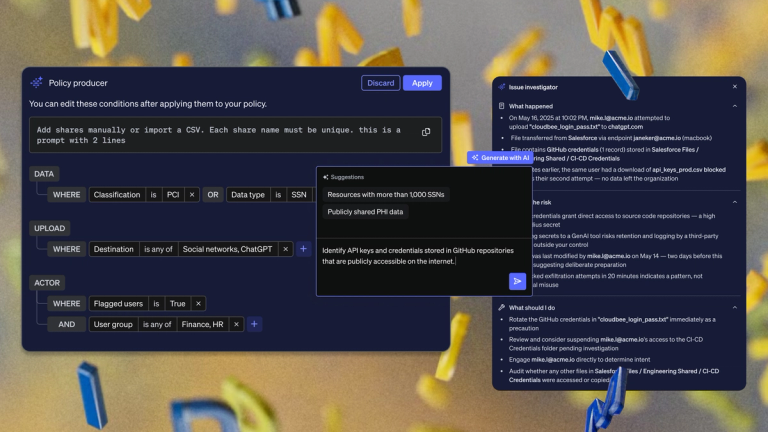
An agentic attacker operates at machine speed, so the control watching your data has to keep pace. MIND classifies sensitive data by understanding both content and context. It knows what the data is, where it lives, who or what is touching it and where it's headed. When sensitive data starts moving somewhere it shouldn't, whether at rest or in motion, MIND blocks the exfiltration in real time instead of filing an alert for the morning queue.
We aren't just watching data move. We're minding the blast radius of the intrusion you didn't see coming, so a compromised worker produces an incident report instead of a leak.
A weekend-long lateral-movement campaign generates exactly the kind of low-and-slow signal that drowns in false positives. Context-aware classification is what separates an engineer's routine data pull from an agent staging your crown jewels for exfiltration. That's DLP at AI Speed, and it's the difference between reading about a breach and reading about your breach.
What should security teams do before the next agentic attack?
Three moves are worth making now.
- Treat your data pipeline as a first-class attack surface, exactly the lesson Hugging Face drew from its own incident.
- Map where your sensitive data and credentials actually live before an intruder maps it for you.
- Put a control at the exfiltration layer that works at the same speed as the attacker does.
The intrusion is the attacker's move. The data loss is yours to prevent. See what MIND looks like in your environment.
Sources
- Hugging Face: Security incident disclosure, July 2026
- BleepingComputer: Hugging Face warns an autonomous AI agent hacked its network
- OpenAI: OpenAI and Hugging Face partner to address security incident during model evaluation
- TechCrunch: OpenAI says Hugging Face was breached by its pre-release models
- Fortune: OpenAI says its AI models escaped a secure test environment and hacked Hugging Face