






An agent's identity tells you who asked for the file. Only the data can tell you what left with it.
An agent's identity tells you who asked for the file. Only the data can tell you what left with it.
Almost every organization now has a written policy for what its AI agents can touch. In Delinea's 2026 Identity Security Report, covered by Help Net Security, 99.7% of IT and security leaders said they had a formal policy governing the data AI tools and agents could access. Most of them also reported or suspected that an AI tool or agent had reached sensitive data beyond what its task required in the past year.
Only about 51% of organizations in the Delinea research check AI access against that policy in real time. Fewer than one in five detected the most recent out-of-scope access as it happened.
If you run security at a company racing to deploy agents, that gap probably sounds familiar. The policy was signed months ago. Nobody can say with confidence what the agent opened last Tuesday.
Why do AI agents reach more sensitive data than their task needs?
Delinea's findings point to how access gets granted in the first place. Agents often inherit the permissions of the person who launches them, including privileges that employee built up over years. Business teams connect tools through their own work accounts, sometimes without IT or security approval. Once connected, those permissions tend to stay active long after the task ends. Forty-two percent of IT and security leaders told Delinea their organization had no automatic way to remove AI access when a session ended.
Okta's Global CISO Insights 2026 survey of 306 security executives shows the same pattern from the identity side. Fewer than half are confident they can identify every AI agent in their environment (47%) or centrally control what those agents can access (46%). One in four CISOs told Okta they treat agents exactly as they treat human identities. Another 21% govern agent access with shared credentials or service accounts that carry broad permissions.
None of this is negligence. The business moves at AI speed. Most access controls were designed for people who log in, open a handful of files and then log off for the night.
Why can't identity controls alone stop AI agent data exposure?
Identity is the right place to start. It answers which agent is acting and on whose behalf. What it can't answer by itself is what that agent just read or where the contents are headed next.
Picture an agent with legitimate access to a SharePoint site. In a few seconds it can open a board deck, a payroll export and a folder of customer contracts. Every one of those requests is allowed from an identity standpoint. The question that matters is whether that data belongs in the agent's context at all. It might end up in a prompt sent to an external model or in a file written to a shared drive.
Delinea found that only 36% of IT respondents could always trace an AI access event involving sensitive data back to the person who authorized it. Respondents often reported taking a day or longer to detect the most recent out-of-scope access. A day is a long time for software that acts at machine speed.
Part of the problem is how the work gets divided. Identity tools govern who gets in. A posture tool maps where sensitive data sits at rest, while a separate DLP product watches some of the channels it moves through. Each sees a slice of the picture. An agent can move through the space between them without tripping any single control.
What does complete data security look like for AI agents?
It doesn't have to be this fragmented. Of course your agents touch sensitive data. They're doing work for a business that runs on that data. The goal is to let them work within the same boundaries you'd expect of a person.
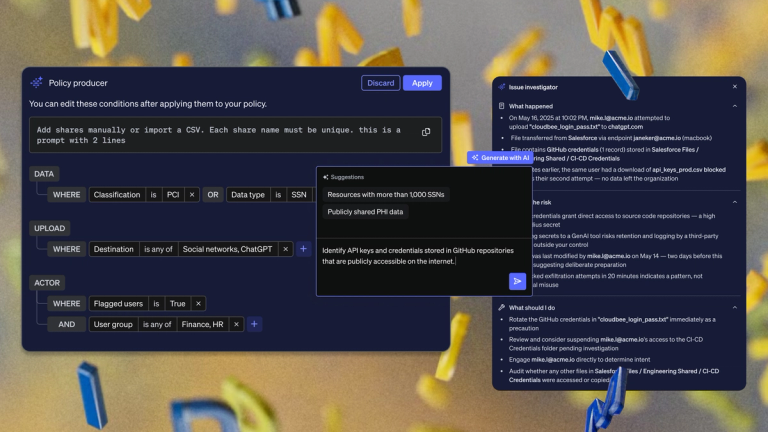
MIND's Complete pillar starts from that idea. Discovery, detection and prevention run in one platform across data at rest and data in motion. In practice that looks like this:
- Discovery wherever data lives. MIND connects to SaaS apps, on-premise file shares, endpoints, email and AI tools. It classifies what it finds by content and context, beyond regex, so you know which folders hold payroll exports before an agent does.
- Remediation at rest. When sensitive files are overexposed, MIND can remove public links, adjust permissions or escalate to the owner. That shrinks what an agent inherits on day one.
- Prevention in motion. Real-time controls on the endpoint and in the browser stop sensitive data from going where it shouldn't, with no network SSL inspection required.
- Identity and data together. Controls understand who's touching what, including agentic AI identities. Agents acting on behalf of people get the same data boundaries as the people themselves.
The point is to keep minding the line between what an agent was asked to do and what it actually touched. Your team shouldn't have to rebuild that line a day later from three different consoles.
MIND also works alongside what you already run. If you rely on Microsoft Purview or your own labelling scheme, those existing labels get smarter instead of being replaced.
How do security teams close the AI agent enforcement gap?
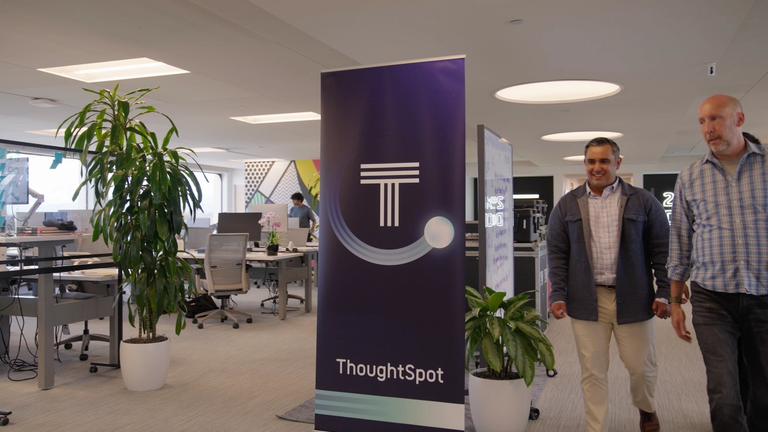
Closing the gap starts with one view of the data and the identities touching it. Al Faiella, Senior Director of Security Engineering at ThoughtSpot, described what that changed for his team.
“MIND allows us to see and protect our data across every vector, endpoints and SaaS, from a single place. It's like having a spotlight that shines where visibility didn't exist before.”
Al Faiella
Senior Director of Security Engineering, ThoughtSpot
That spotlight matters more as agents multiply. When posture and prevention share one architecture, your team sees the data and the identity behind each action in one place. Nobody has to stitch the story together from separate tools after the fact.
Your agents will keep multiplying. Your policies are probably already written. The next step is finding out whether your data follows them.
Book a demo to see how MIND covers data at rest and in motion from one platform, running in your own environment within minutes. That's Stress-Free DLP for the AI era.