





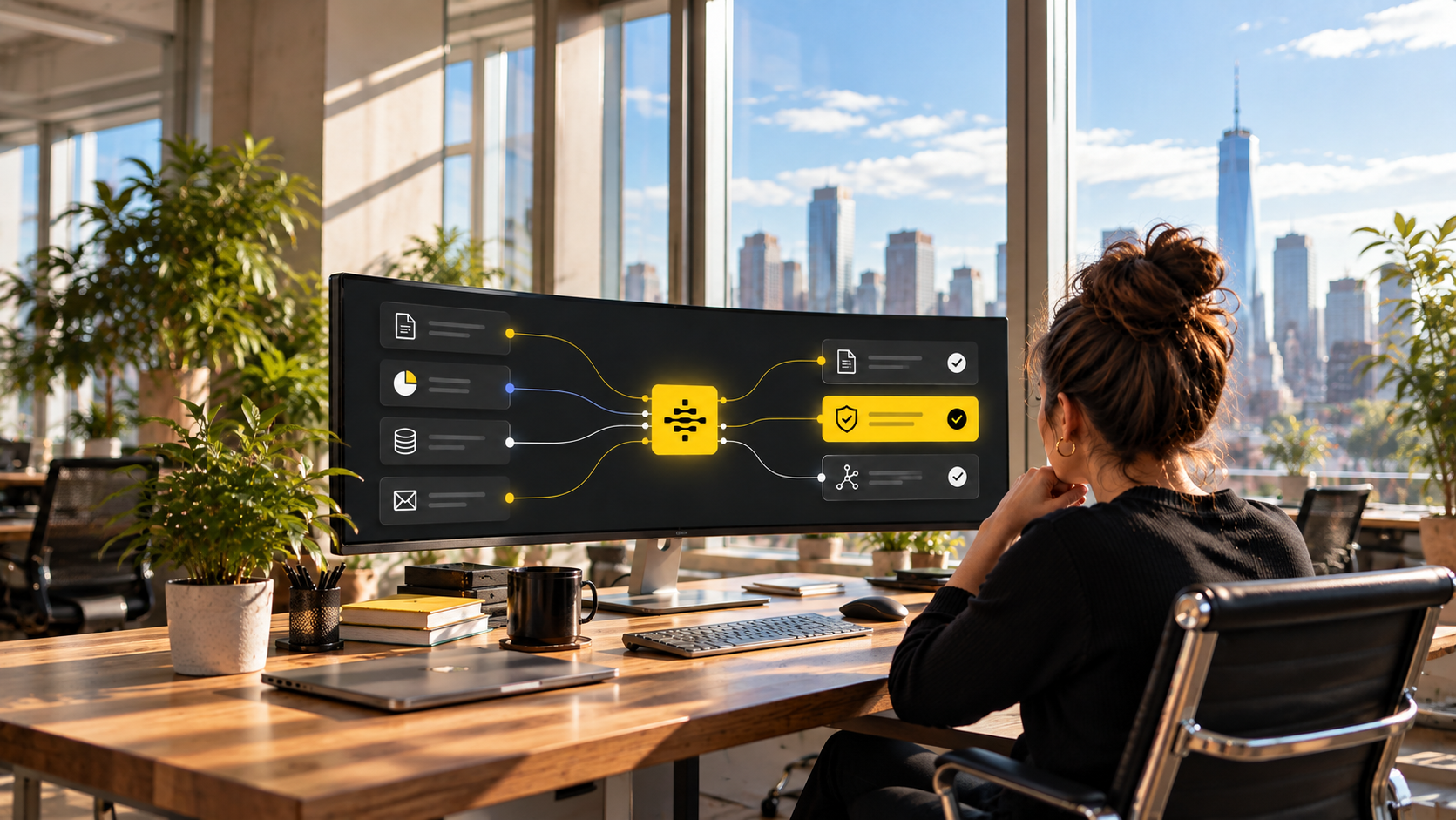
Autonomy earns its keep when your team can see the reasoning and still keep the final say.
Autonomy earns its keep when your team can see the reasoning and still keep the final say.
Security teams are adopting AI faster than they're learning to trust it. N-able's AI Fog Report, a survey of 595 cybersecurity decision-makers and practitioners in the US and UK published on October 15, found that 75.5% of organizations don't fully trust AI-powered remediation without a human reviewing it first.
That caution is earned. Most teams have bought a tool that promised to run itself and then needed constant supervision. The pressure isn't easing either. Most respondents said alert volumes rose over the past year. Nearly 90% said they'd made at least minor security policy exceptions to let AI tools in, according to Channel Dive's coverage of the findings.
So the real question for data security is what automation has to show before a CISO will let it act on sensitive data.
Why don't security teams trust autonomous AI remediation yet?
The N-able data points to two gaps.
The first is context. Among the sources of low-quality signal respondents named, 48.9% pointed to AI-generated alerts that lacked sufficient context. Another 50.4% pointed to duplicate alerts from overlapping tools. An alert that can't explain itself asks the analyst to rebuild the story from scratch. If a tool can't explain a simple alert, nobody wants it removing a public link or blocking an upload on its own.
The second is control. Of those surveyed, 59.8% said they need a built-in human override before they'll trust autonomous AI. Only 51.9% keep a comprehensive inventory of the AI tools running in their environment, which leaves many teams being asked to trust automation inside an estate they can't fully see.
Filigran found a sharper version of the same instinct at Infosecurity Europe 2026. Only 8% of the 168 security leaders it surveyed said they'd trust AI to make security decisions without human approval, as Infosecurity Magazine reported.
What does legacy DLP automation get wrong?
For data security, the trust problem started long before generative AI. Legacy DLP automated the wrong layer. It matched patterns and fired alerts, then left classification judgment and remediation to people. Regex rules can't tell a payroll report from a spreadsheet that happens to hold nine-digit numbers. The queue fills with false positives and the team learns to second-guess every alert.
Adding an AI model on top of that architecture rarely helps. The model inherits noisy inputs and adds a layer of reasoning nobody can inspect. Just under half of N-able's respondents said AI has introduced greater complexity into their security operations, per Channel Dive. A stack built this way explains why.
How can autonomous DLP earn a security team's trust?
It doesn't have to be this way. Autonomy that a security team will accept tends to understand the data before it acts. It explains what it found in plain language. And it works within limits the team sets, escalating anything outside them.
How does MIND make autonomous DLP explainable and controllable?
MIND was built AI-native from day one, so autonomy sits at the core of the platform instead of on top of it. Each of those traits maps to something the platform does today.
Understanding comes first. MIND classifies data with multiple AI layers that read both content and context, going beyond regex and pattern-matching. It recognizes contracts, medical records, payroll reports, board minutes, source code and many other data types. Better classification upstream means fewer alerts downstream that anyone has to defend.
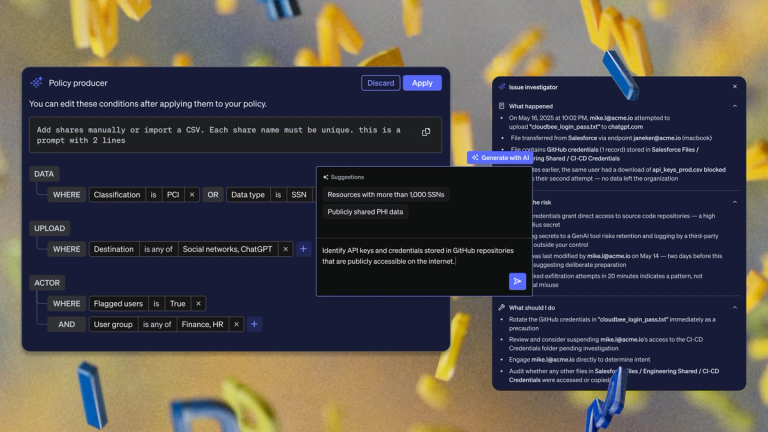
Explanation comes next. MIND's AI DLP Agents include an Issue Investigator agent that analyzes each incident, uncovers patterns and explains the risk. Your analyst starts from a finished summary instead of a raw event.
Control stays with your team. The Rapid Response agent executes remediation actions and escalates when human approval is required. Prevention runs on adaptive controls, so the response to a risky paste or upload can be a block, a speed bump, a coaching prompt or monitoring alone, matched to severity. A Policy Producer agent suggests, creates and refines policies from observed behavior and natural-language instructions. That gives teams a way to keep pace with new AI tools without writing every rule by hand or carving out exceptions.
The system handles classification, investigation and routine remediation. Your analysts keep the judgment calls. MIND is focused on the integrity of your data around the clock, so your team can spend its attention where a human view changes the outcome.
What does trusted autonomous DLP look like in practice?
When alerts carry context, analysts stop re-checking them.
“When an alert comes from MIND, we know for a fact it's worth following up on. That's hugely valuable.”
Richard Reinders
VP of Information Security, Gravity Payments
That confidence shows up in the workload. OpenWeb's team spends 80% less effort managing its DLP program than before. Noname Security saved 25-50% of the time it spent on each incident. At Guild, VP of Information Security Julie Chickillo said she "didn't need to hire three to four people just to manage MIND."
Where should a security leader start with autonomous DLP?
Trust in autonomy is easiest to judge in your own environment. MIND deploys in minutes and delivers insights within 24 hours. You can watch how it classifies your data and what it surfaces before you decide how much it should act on its own. Book a demo and see DLP on Autopilot with your team still holding the controls.
Let's mind what matters.